trevor is studying a polynomial function f(x). three given roots of f(x) are -7, 2i, and 7. trevor concludes…
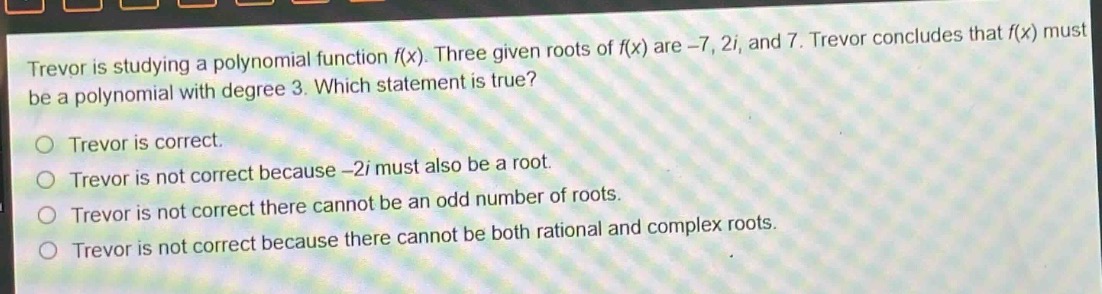
trevor is studying a polynomial function f(x). three given roots of f(x) are -7, 2i, and 7. trevor concludes that f(x) must be a polynomial with degree 3. which statement is true?\no trevor is correct.\no trevor is not correct because -2i must also be a root.\no trevor is not correct there cannot be an odd number of roots.\no trevor is not correct because there cannot be both rational and complex roots.
Answer
Explanation:
Step1: Recall complex - conjugate root theorem
If a polynomial with real - coefficients has a complex root (a + bi), then its complex conjugate (a - bi) is also a root. Since (2i) is a root of (f(x)) and (f(x)) is a polynomial (assumed to have real coefficients, as is common in basic polynomial studies), then (- 2i) must also be a root.
Step2: Determine the degree of the polynomial
The roots of the polynomial are (-7), (2i), (7), and (-2i). The degree of a non - zero polynomial is equal to the number of its roots (counting multiplicities). Here, there are at least 4 roots. So the degree of the polynomial is at least 4.
Answer:
Trevor is not correct because (-2i) must also be a root.