in triangle abc, the segments drawn from the vertices intersect at point g. segment fg measures 6 cm, and…
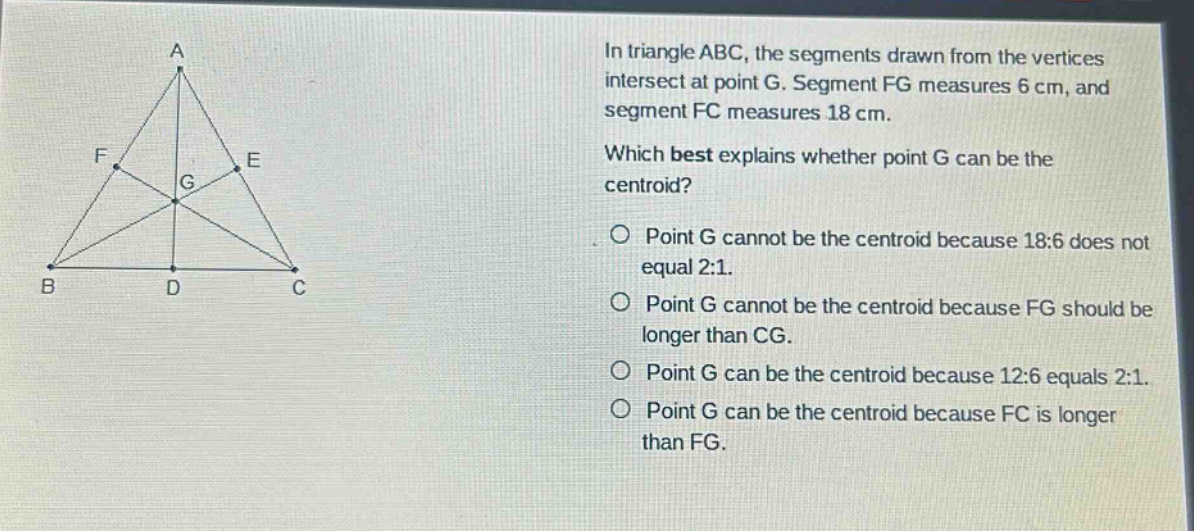
in triangle abc, the segments drawn from the vertices intersect at point g. segment fg measures 6 cm, and segment fc measures 18 cm. which best explains whether point g can be the centroid? point g cannot be the centroid because 18:6 does not equal 2:1. point g cannot be the centroid because fg should be longer than cg. point g can be the centroid because 12:6 equals 2:1. point g can be the centroid because fc is longer than fg.
Answer
Explanation:
Step1: Recall centroid property
The centroid of a triangle divides each median in a ratio of 2:1, where the longer segment is towards the vertex. If $FC$ is a median and $G$ is the centroid, then $FG:GC = 1:2$ and $FC=FG + GC$.
Step2: Calculate length of $GC$
Given $FC = 18$ cm and $FG=6$ cm, then $GC=FC - FG=18 - 6=12$ cm.
Step3: Check the ratio
The ratio of $FG$ to $GC$ is $FG:GC = 6:12=1:2$, which is the correct ratio for the centroid - median relationship.
Answer:
Point G can be the centroid because 12:6 equals 2:1.