triangle abc was transformed using the rule (x, y)→(-y, x). the vertices of the triangles are shown. a(-1…
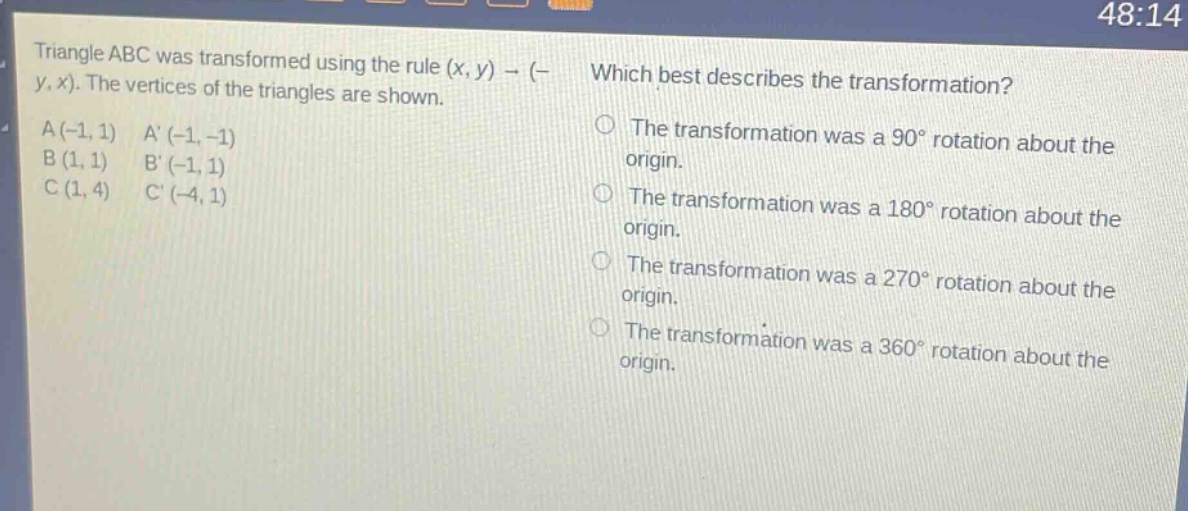
triangle abc was transformed using the rule (x, y)→(-y, x). the vertices of the triangles are shown. a(-1, 1) a(-1, -1) b(1, 1) b(-1, 1) c(1, 4) c(-4, 1) which best describes the transformation? the transformation was a 90° rotation about the origin. the transformation was a 180° rotation about the origin. the transformation was a 270° rotation about the origin. the transformation was a 360° rotation about the origin.
Answer
Answer:
The transformation was a 270° rotation about the origin.
Explanation:
Step1: Recall rotation rules
For a 90 - degree rotation about the origin, the rule is $(x,y)\to(-y,x)$. For a 180 - degree rotation, $(x,y)\to(-x,-y)$. For a 270 - degree rotation, $(x,y)\to(y, - x)$. For a 360 - degree rotation, $(x,y)\to(x,y)$.
Step2: Analyze given rule
The given rule is $(x,y)\to(-y,x)$. This is the rule for a 270 - degree counter - clockwise rotation about the origin. We can also check with the vertices: For point $A(-1,1)$, applying the rule $(x,y)\to(-y,x)$ gives $A'(-1,-1)$. For point $B(1,1)$, applying the rule gives $B'(-1,1)$. For point $C(1,4)$, applying the rule gives $C'(-4,1)$. So the transformation is a 270 - degree rotation about the origin.