triangle abc was translated to form abc. which describes the transformation? select three options. it is…
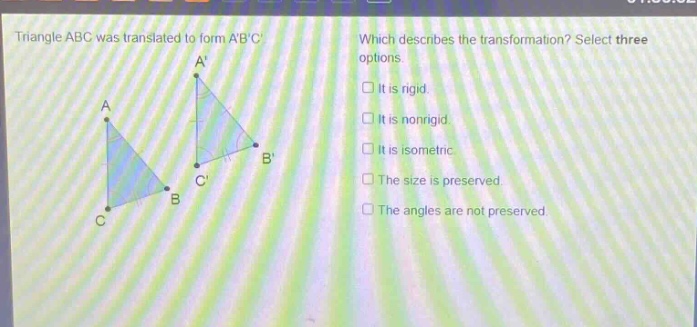
triangle abc was translated to form abc. which describes the transformation? select three options. it is rigid. it is nonrigid. it is isometric. the size is preserved. the angles are not preserved.
Answer
Answer:
- It is rigid
- It is isometric
- The size is preserved
Explanation:
Step1: Understand rigid transformation
A translation is a rigid transformation. Rigid transformations preserve shape and size.
Step2: Define isometric transformation
Translations are isometric. Isometric transformations have the property that the distance between any two - points in the pre - image is the same as the distance between their corresponding points in the image, meaning size and shape are maintained.
Step3: Analyze preservation of size and angles
In a translation, the size of the figure (including side lengths and area) and the measures of the angles are preserved. So, the size is preserved and the angles are also preserved.