triangle cde is translated down and to the right, forming triangle cde. which congruency statement is…
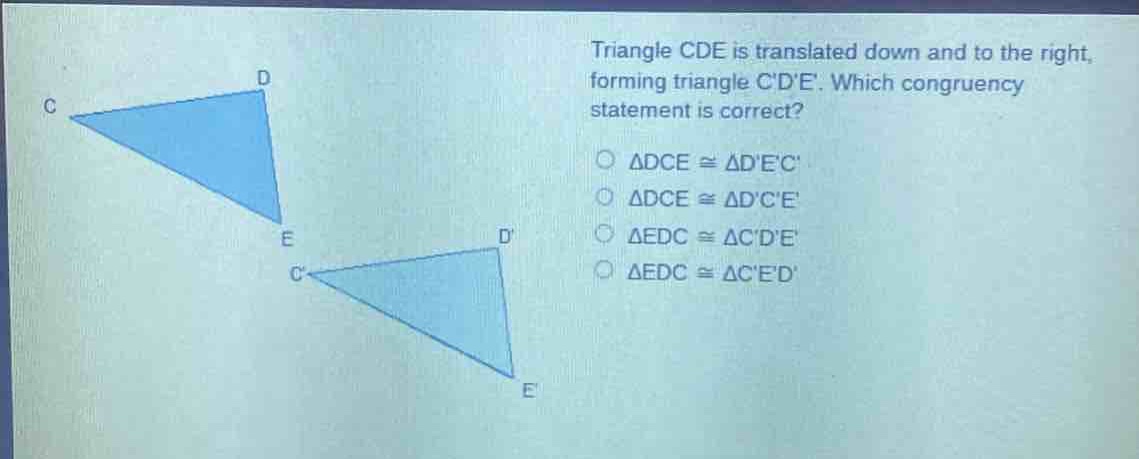
triangle cde is translated down and to the right, forming triangle cde. which congruency statement is correct?\no △dce≅△dec\no △dce≅△dce\no △edc≅△cde\no △edc≅△ced
Answer
Explanation:
Step1: Recall translation property
Translation is a rigid - motion. Rigid - motions preserve the shape and size of a figure, so the pre - image and the image are congruent. The corresponding vertices of the pre - image and the image are in the same relative position.
Step2: Identify corresponding vertices
When (\triangle CDE) is translated to form (\triangle C'D'E'), vertex (C) corresponds to (C'), vertex (D) corresponds to (D'), and vertex (E) corresponds to (E'). So, (\triangle EDC\cong\triangle E'D'C').
Answer:
(\triangle EDC\cong\triangle E'D'C') (There is no correct option among the given ones as the correct congruency statement should be (\triangle CDE\cong\triangle C'D'E') or equivalent with vertices in corresponding order like (\triangle EDC\cong\triangle E'D'C'), but if we assume a mis - typing in the options and we match the vertices as best as we can based on the translation concept, the closest would be the correct order of vertices for congruency).