a triangle on a coordinate plane is translated according to the rule $t_{-3,5}(x,y)$. which is another way…
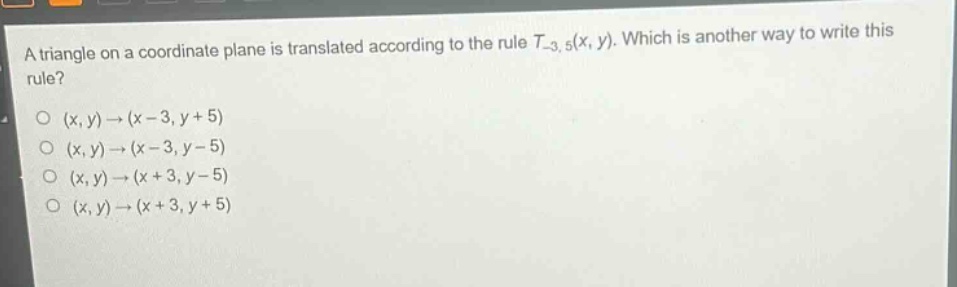
a triangle on a coordinate plane is translated according to the rule $t_{-3,5}(x,y)$. which is another way to write this rule?\n$(x,y)\to(x - 3,y + 5)$\n$(x,y)\to(x - 3,y - 5)$\n$(x,y)\to(x + 3,y - 5)$\n$(x,y)\to(x + 3,y + 5)$
Answer
Explanation:
Step1: Understand translation rule
In the rule $T_{- 3,5}(x,y)$, the first number -3 represents the horizontal translation and the second number 5 represents the vertical translation.
Step2: Apply horizontal translation
A negative number for the first - coordinate in the translation rule means a shift to the left. For the $x$ - coordinate of a point $(x,y)$, a shift of -3 units horizontally means $x$ becomes $x-3$.
Step3: Apply vertical translation
A positive number for the second - coordinate in the translation rule means a shift up. For the $y$ - coordinate of a point $(x,y)$, a shift of 5 units vertically means $y$ becomes $y + 5$.
Step4: Write the new rule
The translation rule for the point $(x,y)$ is $(x,y)\to(x - 3,y+5)$.
Answer:
$(x,y)\to(x - 3,y+5)$