triangle def was dilated according to the rule $d_{o,\frac{1}{3}}(x,y)\to(\frac{1}{3}x,\frac{1}{3}y)$ to…
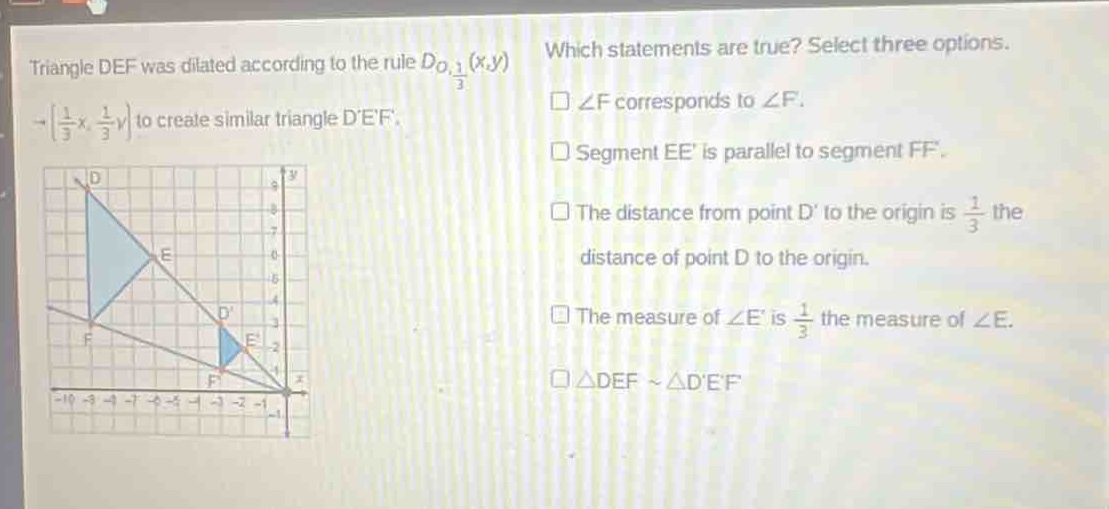
triangle def was dilated according to the rule $d_{o,\frac{1}{3}}(x,y)\to(\frac{1}{3}x,\frac{1}{3}y)$ to create similar triangle def. which statements are true? select three options. $angle f$ corresponds to $angle f$. segment ee is parallel to segment ff. the distance from point d to the origin is $\frac{1}{3}$ the distance of point d to the origin. the measure of $angle e$ is $\frac{1}{3}$ the measure of $angle e$. $\triangle defsim\triangle def$
Answer
Explanation:
Step1: Recall dilation properties
Dilation is a transformation that changes the size of a figure but not its shape. Corresponding angles of similar figures (pre - image and image after dilation) are congruent. So, $\angle F$ corresponds to $\angle F'$ and $\triangle DEF\sim\triangle D'E'F'$.
Step2: Analyze side - length and distance relationships
When a point $(x,y)$ is dilated by a scale factor $k$ with the center of dilation at the origin $(0,0)$ using the rule $D_{O,k}(x,y)=(kx,ky)$, the distance from the origin to the image of a point is $k$ times the distance from the origin to the pre - image point. Here $k = \frac{1}{3}$, so the distance from point $D'$ to the origin is $\frac{1}{3}$ the distance of point $D$ to the origin.
Step3: Analyze parallel segments
The lines connecting corresponding points of the pre - image and image after dilation are concurrent at the center of dilation. So, segment $EE'$ and segment $FF'$ intersect at the center of dilation $O$, and they are not parallel. Also, since corresponding angles of similar triangles are congruent, $m\angle E'=m\angle E$.
Answer:
- $\angle F$ corresponds to $\angle F'$.
- The distance from point $D'$ to the origin is $\frac{1}{3}$ the distance of point $D$ to the origin.
- $\triangle DEF\sim\triangle D'E'F'$