triangle def was dilated according to the rule $d_{o,\frac{1}{3}}(x,y)\to(\frac{1}{3}x,\frac{1}{3}y)$ to…
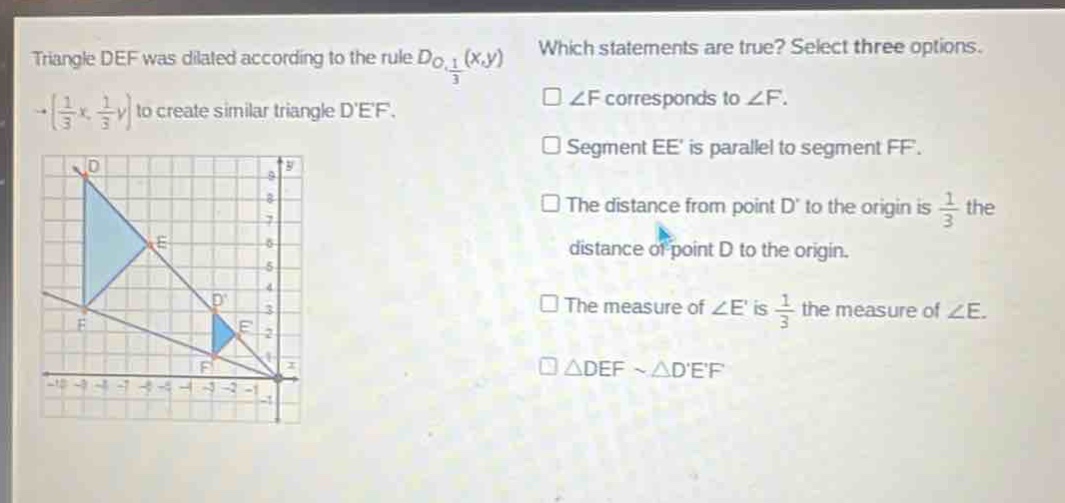
triangle def was dilated according to the rule $d_{o,\frac{1}{3}}(x,y)\to(\frac{1}{3}x,\frac{1}{3}y)$ to create similar triangle def. which statements are true? select three options. $squareangle f$ corresponds to $angle f$. $square$ segment ee is parallel to segment ff. $square$ the distance from point d to the origin is $\frac{1}{3}$ the distance of point d to the origin. $square$ the measure of $angle e$ is $\frac{1}{3}$ the measure of $angle e$. $square\triangle defsim\triangle def$
Answer
Explanation:
Step1: Recall dilation properties
Dilation creates similar figures. Corresponding angles of similar - figures are congruent. So, $\angle F$ in $\triangle DEF$ corresponds to $\angle F'$ in $\triangle D'E'F'$ and $\angle F=\angle F'$, and $\triangle DEF\sim\triangle D'E'F'$.
Step2: Analyze distance property
The dilation rule $D_{O,\frac{1}{3}}(x,y)=(\frac{1}{3}x,\frac{1}{3}y)$ means that the distance from any point $P$ in $\triangle DEF$ to the origin $O$ is multiplied by the scale - factor $\frac{1}{3}$ to get the distance from the corresponding point $P'$ in $\triangle D'E'F'$ to the origin. So, the distance from point $D'$ to the origin is $\frac{1}{3}$ the distance of point $D$ to the origin.
Step3: Analyze angle measure
Since corresponding angles of similar triangles are congruent, $\angle E=\angle E'$, not $\angle E'=\frac{1}{3}\angle E$. Also, segment $EE'$ and segment $FF'$ are not parallel in general for a non - special dilation.
Answer:
$\angle F$ corresponds to $\angle F'$, The distance from point $D'$ to the origin is $\frac{1}{3}$ the distance of point $D$ to the origin, $\triangle DEF\sim\triangle D'E'F'$