triangle jkl is isosceles. the measure of angle j is 72° and the measure of angle k is 36°. which statement…
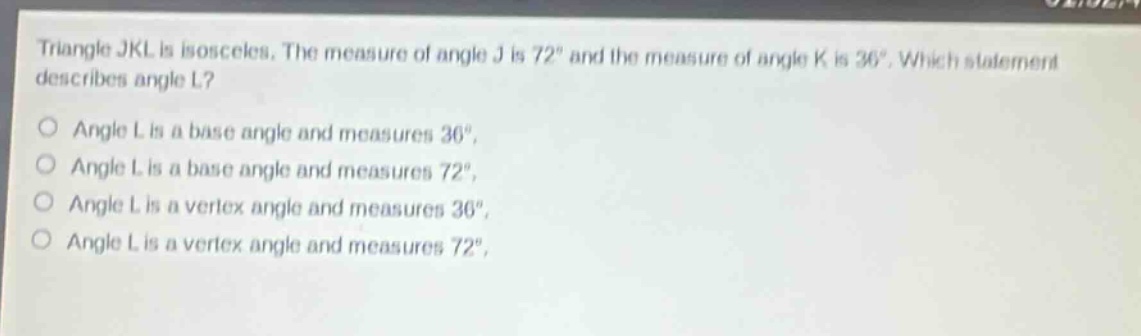
triangle jkl is isosceles. the measure of angle j is 72° and the measure of angle k is 36°. which statement describes angle l?\nangle l is a base angle and measures 36°.\nangle l is a base angle and measures 72°.\nangle l is a vertex angle and measures 36°.\nangle l is a vertex angle and measures 72°.
Answer
Explanation:
Step1: Recall angle - sum property of a triangle
The sum of the interior angles of a triangle is $180^{\circ}$. So, in $\triangle JKL$, we have $\angle J+\angle K+\angle L = 180^{\circ}$.
Step2: Substitute the given angle measures
Given $\angle J = 72^{\circ}$ and $\angle K=36^{\circ}$, we substitute these values into the equation: $72^{\circ}+36^{\circ}+\angle L=180^{\circ}$.
Step3: Solve for $\angle L$
First, simplify the left - hand side: $108^{\circ}+\angle L = 180^{\circ}$. Then, subtract $108^{\circ}$ from both sides: $\angle L=180^{\circ}- 108^{\circ}=72^{\circ}$.
Step4: Determine base and vertex angles in an isosceles triangle
In an isosceles triangle, base angles are equal. Since $\angle J = 72^{\circ}$ and $\angle L=72^{\circ}$, $\angle L$ is a base angle.
Answer:
Angle L is a base angle and measures $72^{\circ}$.