on which triangle can the law of cosines be applied once to find an unknown angle measure? law of cosines…
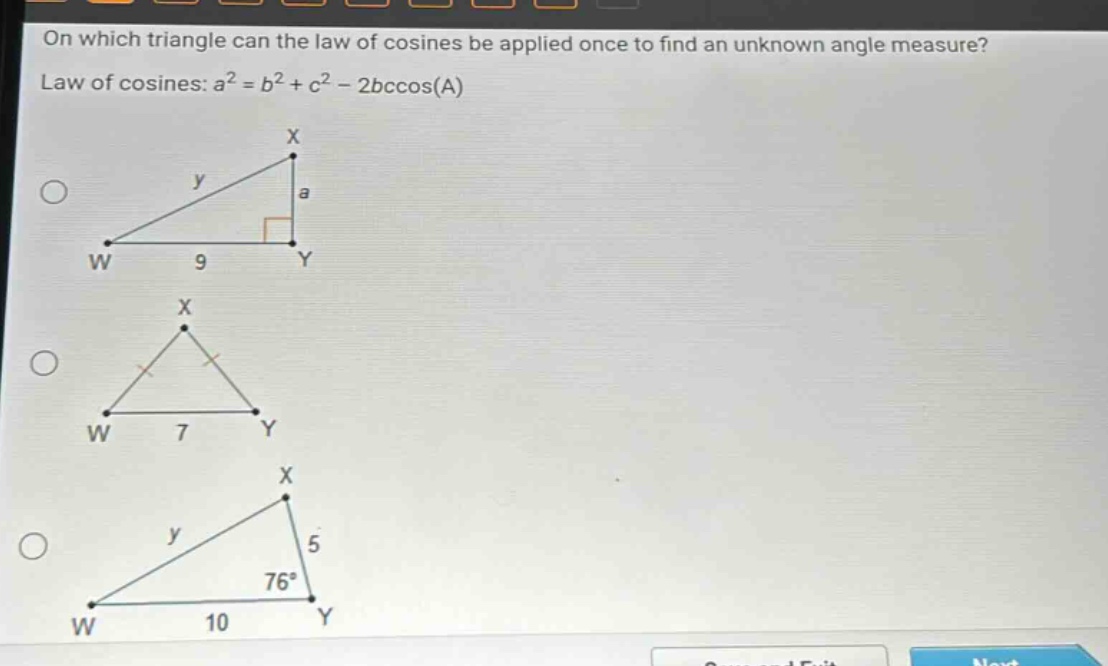
on which triangle can the law of cosines be applied once to find an unknown angle measure? law of cosines: $a^{2}=b^{2}+c^{2}-2bc\\cos(a)$
Answer
Explanation:
Step1: Recall law - of - cosines condition
The law of cosines $a^{2}=b^{2}+c^{2}-2bc\cos(A)$ can be used to find an unknown angle when we know the lengths of all three sides of a triangle or two - side lengths and the included angle.
Step2: Analyze first triangle
In the first right - angled triangle with sides $y$, $9$ and $a$, we don't have enough side - length information to apply the law of cosines to find an angle.
Step3: Analyze second triangle
In the second equilateral - looking triangle with side $7$, we only know one side length and no angle information, so we can't apply the law of cosines.
Step4: Analyze third triangle
In the third triangle, we know side lengths $y$, $5$ and $10$ and the included angle $76^{\circ}$. We can use the law of cosines $a^{2}=b^{2}+c^{2}-2bc\cos(A)$ to find the length of the third side first or re - arrange the formula $\cos(A)=\frac{b^{2}+c^{2}-a^{2}}{2bc}$ to find an unknown angle if we want to find another angle after finding the third side. But we can also directly use it to find the side opposite the $76^{\circ}$ angle first.