on which triangle can the law of cosines be used to find the length of an unknown side? law of cosines…
on which triangle can the law of cosines be used to find the length of an unknown side? law of cosines: $a^{2}=b^{2}+c^{2}-2bc\\cos(a)$
Answer
Explanation:
Step1: Recall law - of - cosines condition
The law of cosines $a^{2}=b^{2}+c^{2}-2bc\cos(A)$ can be used when we know two side - lengths and the included angle of a triangle.
Step2: Analyze first triangle
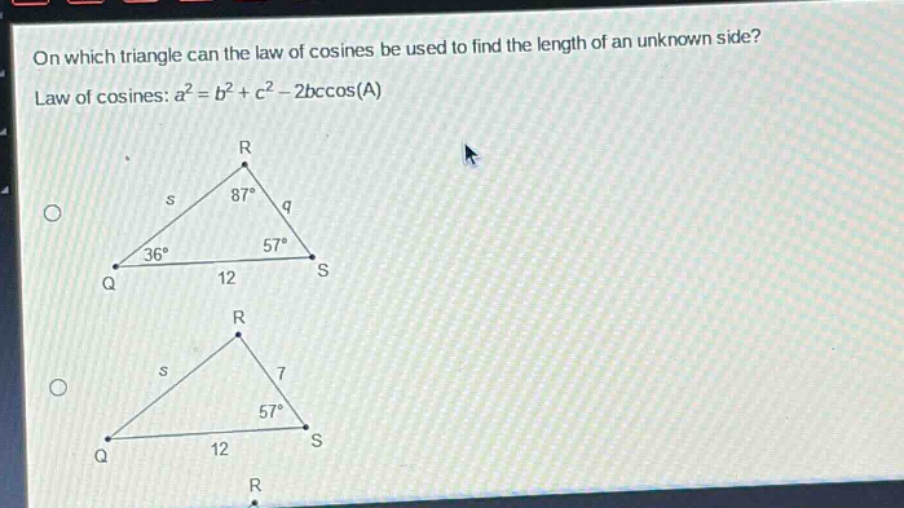
In the first triangle with angles $36^{\circ}$, $57^{\circ}$, $87^{\circ}$ and side $QS = 12$, we do not have two side - lengths and the included angle.
Step3: Analyze second triangle
In the second triangle, we know side $QS=12$, side $RS = 7$, and the included angle $\angle S=57^{\circ}$. So we can use the law of cosines to find the length of side $QR$ (let $QR = s$, $QS=b = 12$, $RS=c = 7$, and $A=\angle S = 57^{\circ}$).
Answer:
The second triangle.