triangle rst was dilated by a scale factor of $\frac{1}{2}$. the image, triangle rst, is an isosceles…
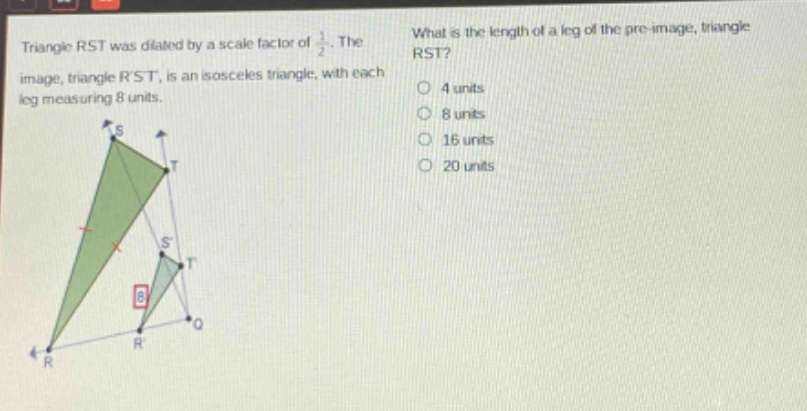
triangle rst was dilated by a scale factor of $\frac{1}{2}$. the image, triangle rst, is an isosceles triangle, with each leg measuring 8 units. what is the length of a leg of the pre - image, triangle rst? 4 units 8 units 16 units 20 units
Answer
Explanation:
Step1: Definir la fórmula de dilatación
Si una figura se dilata por un factor de escala $k$, entonces la longitud de un lado en la imagen $l_{i}$ y la longitud del lado correspondiente en la pre - imagen $l_{p}$ están relacionadas por $l_{i}=k\times l_{p}$. Aquí, $k = \frac{1}{2}$ y $l_{i}=8$.
Step2: Despejar la longitud de la pre - imagen
Reorganizando la fórmula $l_{i}=k\times l_{p}$ para $l_{p}$, obtenemos $l_{p}=\frac{l_{i}}{k}$. Sustituyendo $l_{i} = 8$ y $k=\frac{1}{2}$, tenemos $l_{p}=\frac{8}{\frac{1}{2}}$.
Step3: Calcular la longitud
$\frac{8}{\frac{1}{2}}=8\times2 = 16$.
Answer:
16 units