$\\triangle rst$ and $\\triangle uvw$ are shown below.\nwhich statement is true?\n$\\triangle rst$ is…
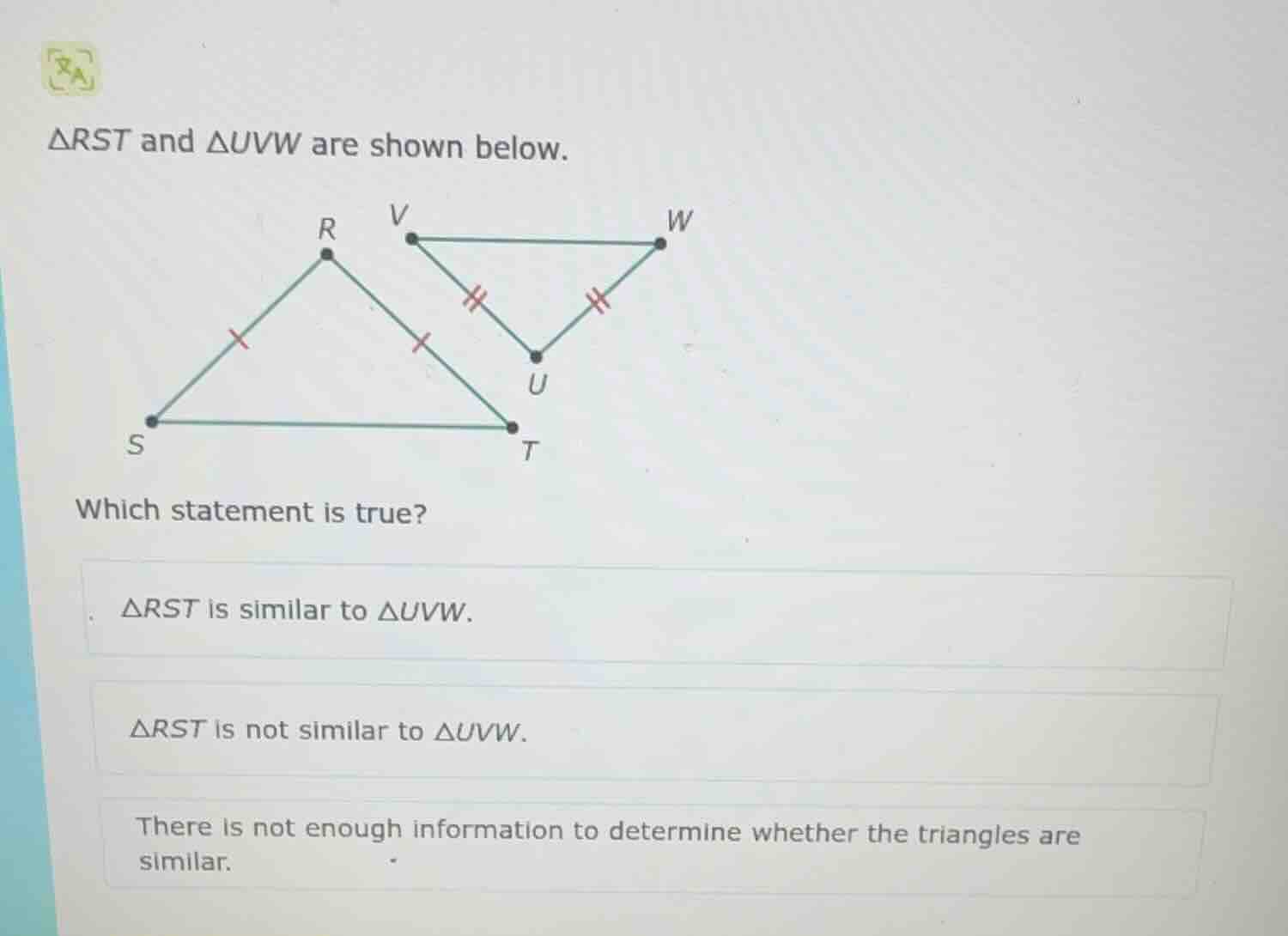
$\\triangle rst$ and $\\triangle uvw$ are shown below.\nwhich statement is true?\n$\\triangle rst$ is similar to $\\triangle uvw$.\n$\\triangle rst$ is not similar to $\\triangle uvw$.\nthere is not enough information to determine whether the triangles are similar.
Answer
Explanation:
Step1: Identify marked sides
In $\triangle RST$, $RS = RT$ (single hash marks). In $\triangle UVW$, $VU = WU$ (double hash marks).
Step2: Analyze similarity conditions
We only know one pair of sides are equal within each triangle (they are isosceles), but we have no information about the ratios of corresponding sides between the two triangles, nor any information about corresponding angles.
Step3: Evaluate similarity
Without side ratio data or angle congruence data, we cannot confirm similarity.
Answer:
There is not enough information to determine whether the triangles are similar.