triangle rst has vertices r(2, 0), s(4, 0), and t(1, -3). the image of triangle rst after a rotation has…
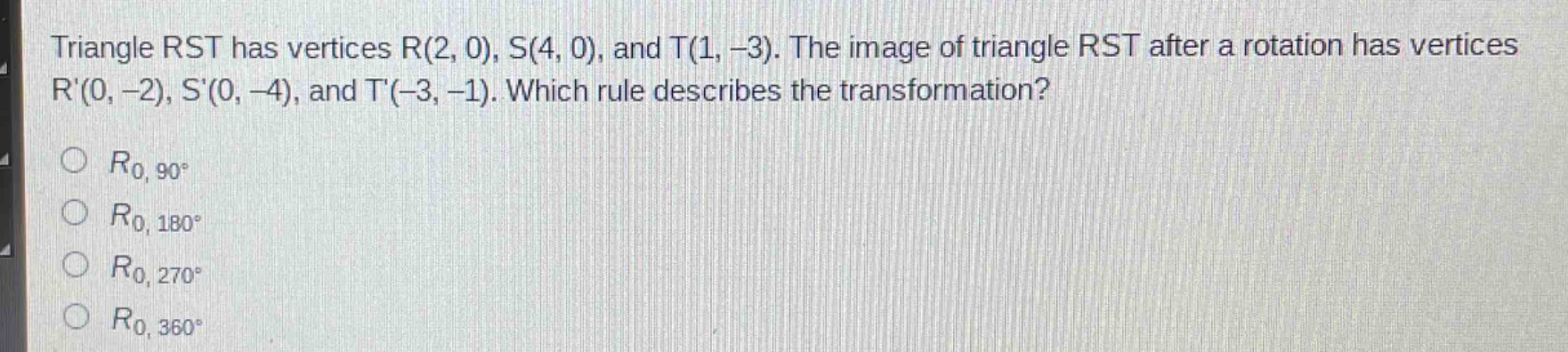
triangle rst has vertices r(2, 0), s(4, 0), and t(1, -3). the image of triangle rst after a rotation has vertices r(0, -2), s(0, -4), and t(-3, -1). which rule describes the transformation?\n$r_{0,90^{circ}}$\n$r_{0,180^{circ}}$\n$r_{0,270^{circ}}$\n$r_{0,360^{circ}}$
Answer
Explanation:
Step1: Recall rotation rules
The general rule for rotating a point $(x,y)$ counter - clockwise about the origin $(0,0)$ by an angle $\theta$ is given by: For a $90^{\circ}$ rotation: $(x,y)\to(-y,x)$; for a $180^{\circ}$ rotation: $(x,y)\to(-x,-y)$; for a $270^{\circ}$ rotation: $(x,y)\to(y, - x)$; for a $360^{\circ}$ rotation: $(x,y)\to(x,y)$.
Step2: Check the rotation of point R
Given $R(2,0)$ and $R'(0, - 2)$. If we apply the rule for a $270^{\circ}$ counter - clockwise rotation about the origin $(x,y)\to(y,-x)$ to $R(2,0)$, we substitute $x = 2$ and $y = 0$: $(2,0)\to(0,-2)$.
Step3: Check the rotation of point S
Given $S(4,0)$ and $S'(0,-4)$. Applying the $270^{\circ}$ counter - clockwise rotation rule $(x,y)\to(y,-x)$ to $S(4,0)$ (substitute $x = 4$ and $y = 0$), we get $(4,0)\to(0,-4)$.
Step4: Check the rotation of point T
Given $T(1,-3)$ and $T'(-3,-1)$. Applying the $270^{\circ}$ counter - clockwise rotation rule $(x,y)\to(y,-x)$ to $T(1,-3)$ (substitute $x = 1$ and $y=-3$), we have $(1,-3)\to(-3,-1)$.
Answer:
$R_{0,270^{\circ}}$