a triangle has vertices at l(2, 2), m(4, 4), and n(1, 6). the triangle is transformed according to the rule…
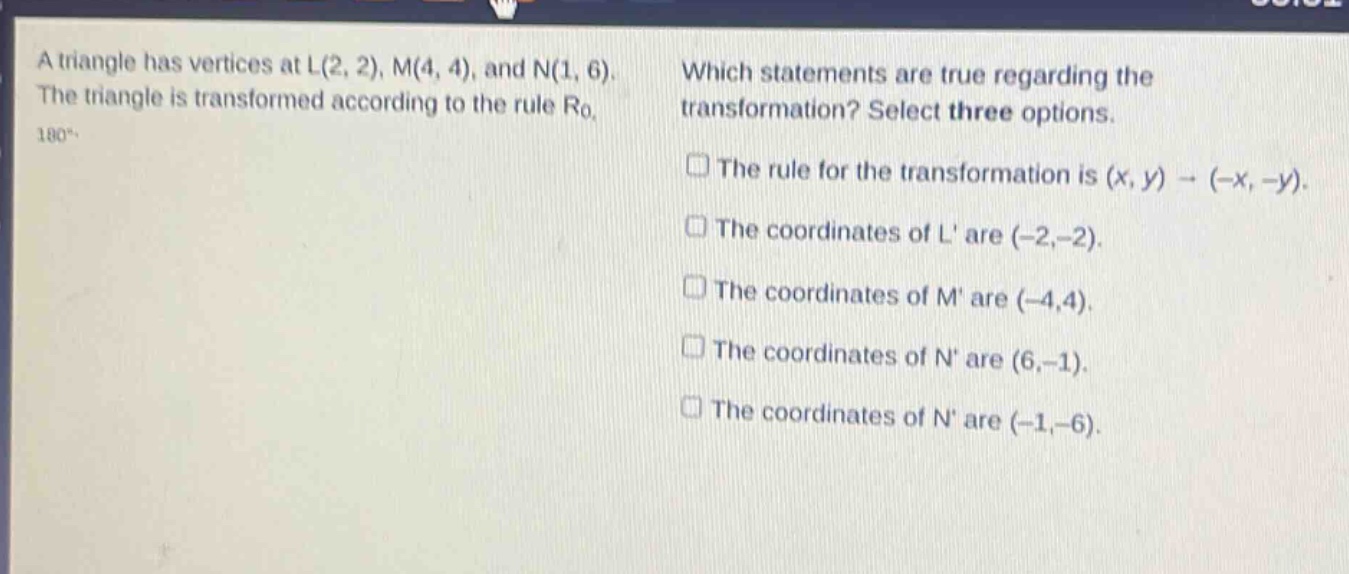
a triangle has vertices at l(2, 2), m(4, 4), and n(1, 6). the triangle is transformed according to the rule r0, 180°. which statements are true regarding the transformation? select three options. the rule for the transformation is (x, y) → (-x, -y). the coordinates of l are (-2,-2). the coordinates of m are (-4,4). the coordinates of n are (6,-1). the coordinates of n are (-1,-6).
Answer
Explanation:
Step1: Recuerda la regla de rotación de 180°
La rotación de 180° en torno al origen tiene la regla $(x,y)\to(-x, -y)$.
Step2: Aplica la regla a L(2, 2)
Para el punto L(2, 2), aplicando la regla $(x,y)\to(-x, -y)$ obtenemos $L'(- 2,-2)$.
Step3: Aplica la regla a M(4, 4)
Para el punto M(4, 4), aplicando la regla $(x,y)\to(-x, -y)$ obtenemos $M'(-4,-4)$.
Step4: Aplica la regla a N(1, 6)
Para el punto N(1, 6), aplicando la regla $(x,y)\to(-x, -y)$ obtenemos $N'(-1,-6)$.
Answer:
- The rule for the transformation is $(x,y)\to(-x, -y)$.
- The coordinates of L' are $(-2,-2)$.
- The coordinates of N' are $(-1,-6)$.