triangle xyz has vertices x(1, 3), y(0, 0), and z(-1, 2). the image of triangle xyz after a rotation has…
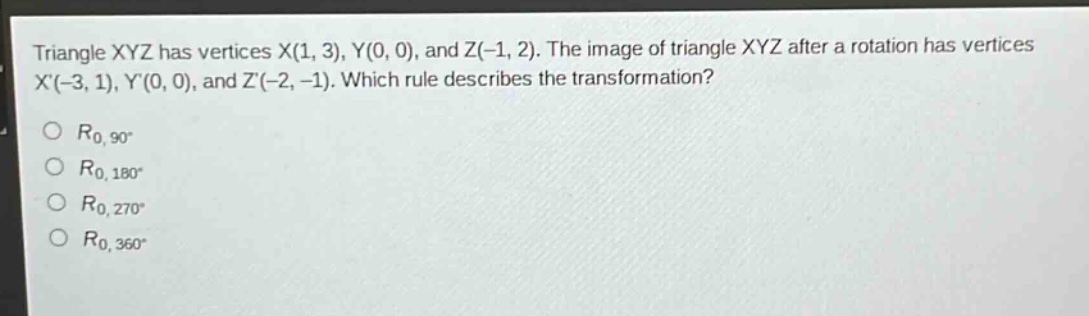
triangle xyz has vertices x(1, 3), y(0, 0), and z(-1, 2). the image of triangle xyz after a rotation has vertices x(-3, 1), y(0, 0), and z(-2, -1). which rule describes the transformation?\n$r_{0,90^{circ}}$\n$r_{0,180^{circ}}$\n$r_{0,270^{circ}}$\n$r_{0,360^{circ}}$
Answer
Explanation:
Step1: Record las reglas de rotación
La rotación de un punto $(x,y)$ en torno al origen $(0,0)$ por un ángulo $\theta$ sigue las siguientes reglas:
- $R_{0,90^{\circ}}$: $(x,y)\to(-y,x)$
- $R_{0,180^{\circ}}$: $(x,y)\to(-x,-y)$
- $R_{0,270^{\circ}}$: $(x,y)\to(y, - x)$
- $R_{0,360^{\circ}}$: $(x,y)\to(x,y)$
Step2: Aplicar la regla a un punto
Tomemos el punto $X(1,3)$. Aplicando la regla $R_{0,270^{\circ}}$: Si $(x = 1,y = 3)$, entonces $(x,y)\to(y,-x)$, es decir $(1,3)\to(3,- 1)$ (incorrecto). Aplicando la regla $R_{0,90^{\circ}}$: Si $(x = 1,y = 3)$, entonces $(x,y)\to(-y,x)$, es decir $(1,3)\to(-3,1)$ Aplicando la regla a $Y(0,0)$: $(0,0)\to(0,0)$ Aplicando la regla a $Z(-1,2)$: Si $(x=-1,y = 2)$, entonces $(x,y)\to(-y,x)$ y $(-1,2)\to(-2,-1)$
Answer:
$R_{0,90^{\circ}}$