triangle xyz with vertices x(0, 0), y(0, -2), and z(-2, -2) is rotated to create the image triangle x(0, 0)…
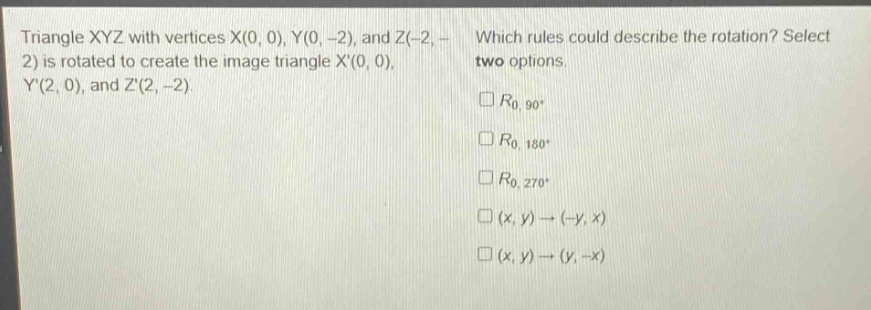
triangle xyz with vertices x(0, 0), y(0, -2), and z(-2, -2) is rotated to create the image triangle x(0, 0), y(2, 0), and z(2, -2). which rules could describe the rotation? select two options. $r_{0,90^{circ}}$ $r_{0,180^{circ}}$ $r_{0,270^{circ}}$ $(x,y)\to(-y,x)$ $(x,y)\to(y, -x)$
Answer
Answer:
C. $R_{0,270^{\circ}}$, D. $(x,y)\to(-y,x)$
Explanation:
Step1: Analyze rotation rules
The general rule for a $90^{\circ}$ counter - clockwise rotation about the origin is $(x,y)\to(-y,x)$, for a $180^{\circ}$ rotation about the origin is $(x,y)\to(-x,-y)$, and for a $270^{\circ}$ counter - clockwise rotation about the origin is $(x,y)\to(y, - x)$.
Step2: Check original and new coordinates
Original points are $X(0,0)$, $Y(0, - 2)$, $Z(-2,-2)$. New points are $X'(0,0)$, $Y'(2,0)$, $Z'(2,-2)$. For point $Y(0, - 2)$, applying $(x,y)\to(-y,x)$ gives $(2,0)$. For point $Z(-2,-2)$, applying $(x,y)\to(-y,x)$ gives $(2,-2)$. Also, a $270^{\circ}$ counter - clockwise rotation ($R_{0,270^{\circ}}$) has the same transformation rule $(x,y)\to(y,-x)$ which also maps the points correctly.