which triangles area can be calculated using the trigonometric area formula?
which triangles area can be calculated using the trigonometric area formula?
Answer
Explanation:
Step1: Recall the trigonometric area formula.
The area of a triangle can be calculated using the formula $Area = \frac{1}{2}ab\sin(C)$, where $a$ and $b$ are the lengths of two sides and $C$ is the measure of the included angle between these two sides.
Step2: Analyze Triangle KLM.
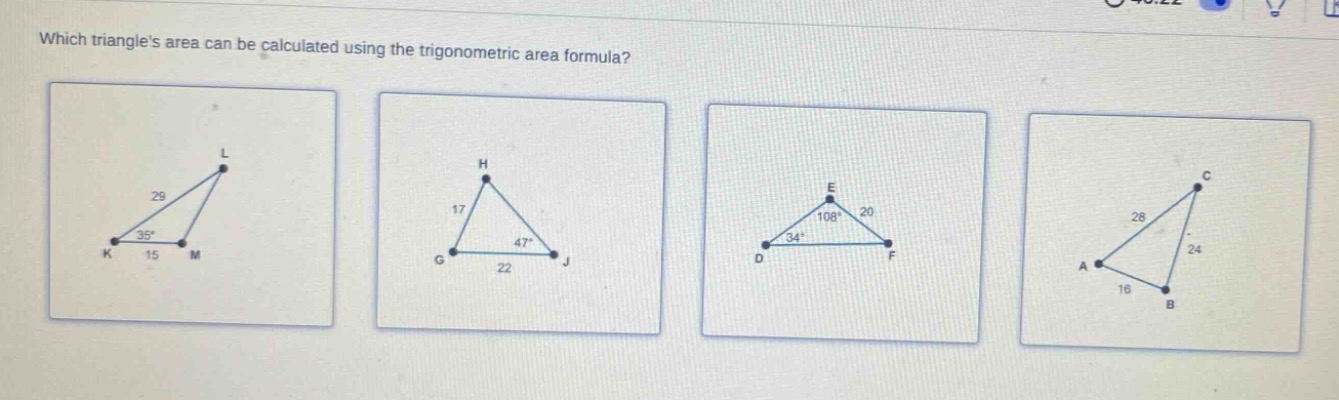
We are given side lengths $KL = 29$ and $KM = 15$, and the included angle $\angle K = 35^\circ$. Since we have two sides and the included angle, we can use the trigonometric area formula. $Area_{KLM} = \frac{1}{2}(KL)(KM)\sin(K) = \frac{1}{2}(29)(15)\sin(35^\circ)$
Step3: Analyze Triangle GHJ.
We are given side lengths $GH = 17$ and $GJ = 22$, and the non-included angle $\angle J = 47^\circ$. The included angle between sides GH and GJ is $\angle G$, which is not given. We cannot directly use the trigonometric area formula with the given information.
Step4: Analyze Triangle DEF.
We are given side length $EF = 20$ and angles $\angle D = 34^\circ$ and $\angle E = 108^\circ$. To use the trigonometric area formula, we need two sides and the included angle. For example, to use $\angle E$, we need sides DE and EF. We only have EF. We cannot directly use the trigonometric area formula with the given information.
Step5: Analyze Triangle ABC.
We are given side lengths $AB = 16$, $BC = 24$, and $AC = 28$. No angles are given. We cannot directly use the trigonometric area formula without first calculating an angle (e.g., using the Law of Cosines).
Step6: Identify the correct triangle.
Only Triangle KLM provides the lengths of two sides and the measure of the included angle, which are the required components for the trigonometric area formula.
Answer:
The first triangle (Triangle KLM)