a triangular prism and its net are shown below. the top and bottom of the prism are shaded. (all lengths are…
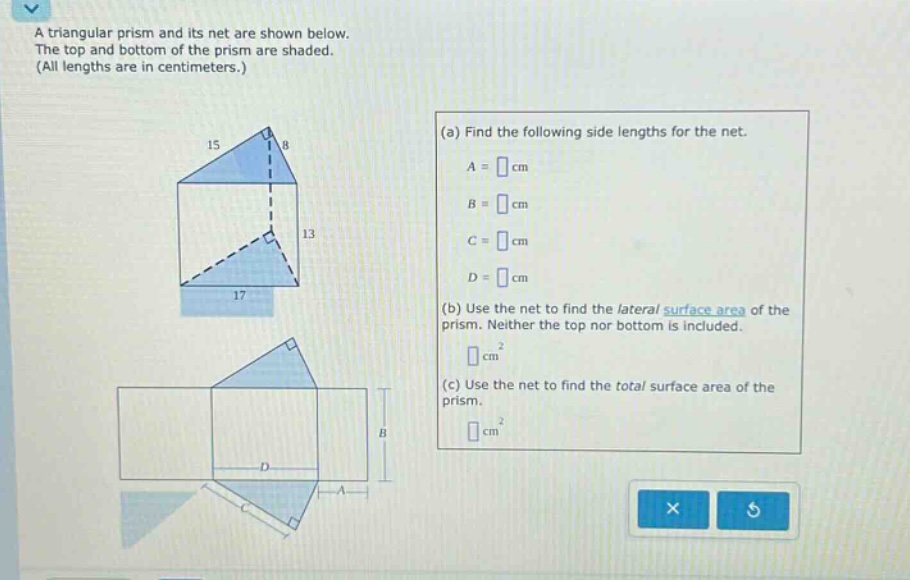
a triangular prism and its net are shown below. the top and bottom of the prism are shaded. (all lengths are in centimeters.) (a) find the following side - lengths for the net. a = cm b = cm c = cm d = cm (b) use the net to find the lateral surface area of the prism. neither the top nor bottom is included. cm² (c) use the net to find the total surface area of the prism. cm²
Answer
Explanation:
Step1: Identify side - lengths
By observing the prism and its net, we can see that: $A = 8$ cm (corresponds to the height of the triangular face), $B = 13$ cm (height of the prism), $C = 15$ cm (hypotenuse of the triangular face), $D = 17$ cm (base of the triangular face).
Step2: Calculate lateral surface area
The lateral surface area of a triangular prism is the sum of the areas of the three rectangular faces. The areas of the rectangular faces are $13\times8$, $13\times15$, and $13\times17$. The lateral surface area $S_{l}=13\times8 + 13\times15+13\times17$ $S_{l}=13\times(8 + 15+17)$ $S_{l}=13\times40=520$ $cm^{2}$.
Step3: Calculate total surface area
First, find the area of the triangular faces. The area of a triangle $A_{t}=\frac{1}{2}\times base\times height=\frac{1}{2}\times17\times8 = 68$ $cm^{2}$. The total surface area $S_{t}=S_{l}+2A_{t}$ $S_{t}=520+2\times68$ $S_{t}=520 + 136=656$ $cm^{2}$.
Answer:
(a) $A = 8$ cm, $B = 13$ cm, $C = 15$ cm, $D = 17$ cm (b) $520$ $cm^{2}$ (c) $656$ $cm^{2}$