which are true of the function $f(x)=49(\\frac{1}{7})^x$? select three options.\nthe domain is the set of…
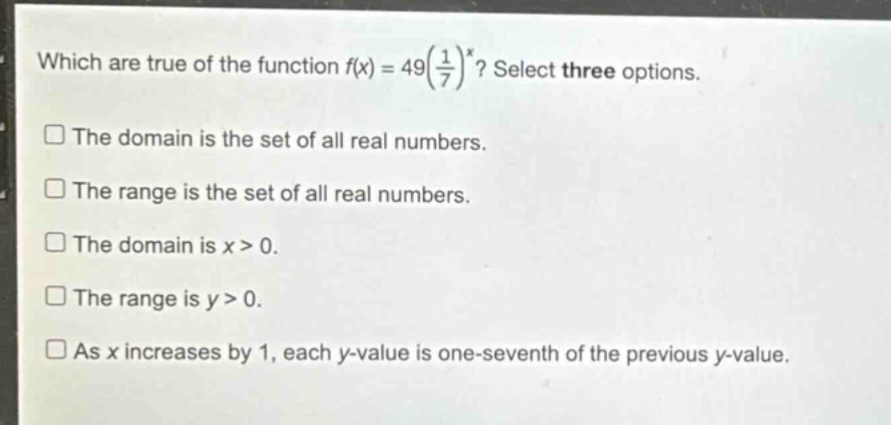
which are true of the function $f(x)=49(\\frac{1}{7})^x$? select three options.\nthe domain is the set of all real numbers.\nthe range is the set of all real numbers.\nthe domain is $x > 0$.\nthe range is $y > 0$.\nas $x$ increases by 1, each $y$-value is one - seventh of the previous $y$-value.
Answer
Explanation:
Step1: Recall domain of exponential function
For an exponential function of the form $y = a\cdot b^{x}$, where $a = 49$ and $b=\frac{1}{7}$, $x$ can take any real - valued input. So the domain of $f(x)=49(\frac{1}{7})^{x}$ is the set of all real numbers.
Step2: Analyze the range of the exponential function
Since $a = 49>0$ and $b=\frac{1}{7}\in(0,1)$, as $x\rightarrow-\infty$, $y = 49(\frac{1}{7})^{x}\rightarrow+\infty$, and as $x\rightarrow+\infty$, $y = 49(\frac{1}{7})^{x}\rightarrow0$ but never reaches $0$. So the range is $y>0$.
Step3: Check the change in $y$ - values
Let $x_1$ and $x_2=x_1 + 1$. Then $f(x_1)=49(\frac{1}{7})^{x_1}$ and $f(x_2)=49(\frac{1}{7})^{x_1 + 1}=49(\frac{1}{7})^{x_1}\cdot\frac{1}{7}$. So as $x$ increases by $1$, each $y$ - value is one - seventh of the previous $y$ - value.
Answer:
The domain is the set of all real numbers. The range is $y>0$. As $x$ increases by $1$, each $y$ - value is one - seventh of the previous $y$ - value.