which must be true of a quadratic function whose vertex is the same as its y - intercept?\nthe axis of…
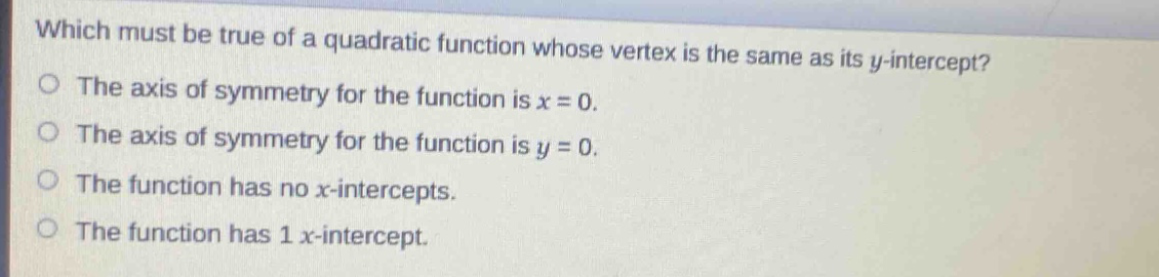
which must be true of a quadratic function whose vertex is the same as its y - intercept?\nthe axis of symmetry for the function is x = 0.\nthe axis of symmetry for the function is y = 0.\nthe function has no x - intercepts.\nthe function has 1 x - intercept.
Answer
Answer:
A. The axis of symmetry for the function is $x = 0$.
Explanation:
Step1: Recall vertex - y - intercept relationship
The y - intercept of a quadratic function $y = ax^{2}+bx + c$ is at the point $(0,c)$. The vertex of a quadratic function in standard form $y=ax^{2}+bx + c$ has x - coordinate $x=-\frac{b}{2a}$. If the vertex and y - intercept are the same, then $-\frac{b}{2a}=0$.
Step2: Solve for b
From $-\frac{b}{2a}=0$, we multiply both sides by $2a$ to get $b = 0$.
Step3: Find axis of symmetry
The formula for the axis of symmetry of a quadratic function $y = ax^{2}+bx + c$ is $x=-\frac{b}{2a}$. When $b = 0$, the axis of symmetry is $x = 0$.
Step4: Analyze x - intercepts
A quadratic function $y=ax^{2}+c$ can have 0, 1, or 2 x - intercepts. For example, if $y=x^{2}+1$ (where $a = 1,c = 1$), it has 0 x - intercepts; if $y=-x^{2}$ (where $a=-1,c = 0$), it has 1 x - intercept; if $y=x^{2}-1$ (where $a = 1,c=-1$), it has 2 x - intercepts. So we cannot be sure about the number of x - intercepts.