two exponential functions are shown in the table. which conclusion about f(x) and g(x) can be drawn from the…
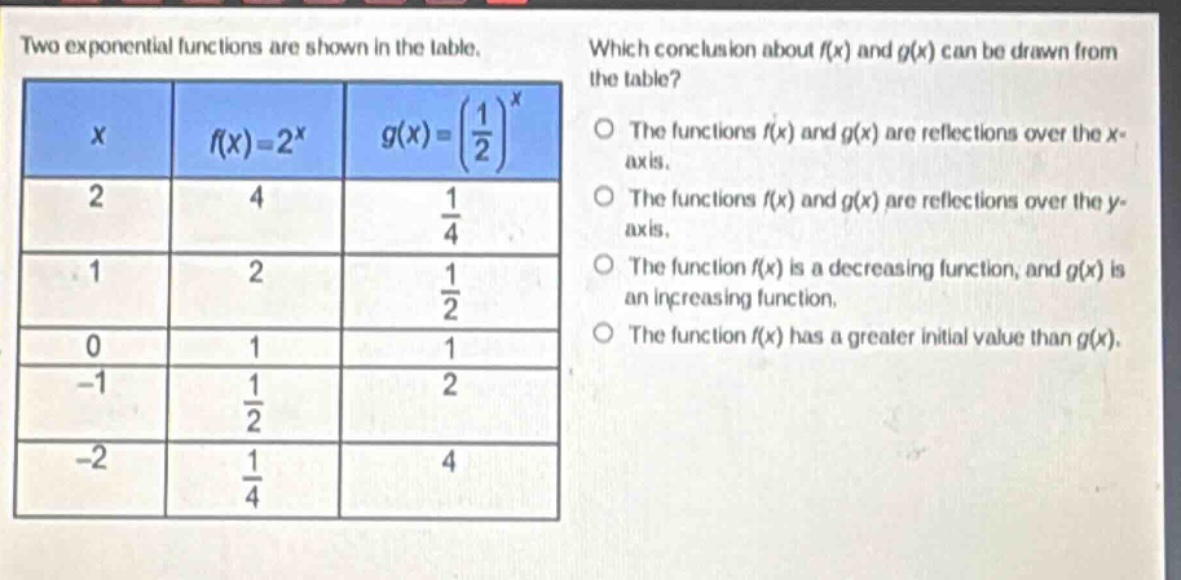
two exponential functions are shown in the table. which conclusion about f(x) and g(x) can be drawn from the table? x f(x)=2^x g(x)=(1/2)^x 2 4 1/4 1 2 1/2 0 1 1 -1 1/2 2 -2 1/4 4 the functions f(x) and g(x) are reflections over the x - axis. the functions f(x) and g(x) are reflections over the y - axis. the function f(x) is a decreasing function, and g(x) is an increasing function. the function f(x) has a greater initial value than g(x).
Answer
Explanation:
Step1: Recall reflection rules
Reflection over x - axis: $y = - f(x)$; reflection over y - axis: $y=f(-x)$.
Step2: Check for y - axis reflection
For $f(x)=2^{x}$ and $g(x)=\left(\frac{1}{2}\right)^{x}=2^{-x}$. When we replace $x$ with $-x$ in $f(x)$, we get $f(-x)=2^{-x}=g(x)$.
Step3: Analyze function behavior
$f(x) = 2^{x}$ is an increasing function ($f(1)=2,f(2) = 4$) and $g(x)=\left(\frac{1}{2}\right)^{x}$ is a decreasing function ($g(1)=\frac{1}{2},g(2)=\frac{1}{4}$). Also, $f(0)=1$ and $g(0)=1$, so they have the same initial - value.
Answer:
The functions $f(x)$ and $g(x)$ are reflections over the y - axis.