two researchers are studying the decline of orangutan populations. in one study, a population of 784…
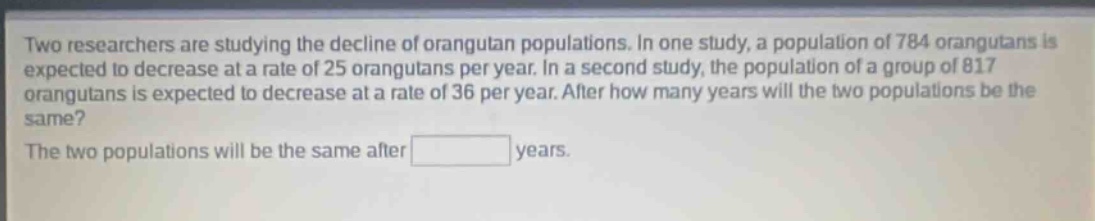
two researchers are studying the decline of orangutan populations. in one study, a population of 784 orangutans is expected to decrease at a rate of 25 orangutans per year. in a second study, the population of a group of 817 orangutans is expected to decrease at a rate of 36 per year. after how many years will the two populations be the same? the two populations will be the same after years.
Answer
Explanation:
Step1: Set up equations
Let $x$ be the number of years. The first - population equation is $y_1 = 784−25x$, and the second - population equation is $y_2 = 817−36x$. When the two populations are the same, $y_1=y_2$, so $784 - 25x=817 - 36x$.
Step2: Solve for $x$
Add $36x$ to both sides of the equation: $784 - 25x+36x=817 - 36x+36x$, which simplifies to $784 + 11x=817$. Then subtract 784 from both sides: $784 + 11x-784=817 - 784$, getting $11x = 33$. Divide both sides by 11: $x=\frac{33}{11}=3$.
Answer:
3