two rigid transformations are used to map △abc to △xyz. the first is a translation of vertex a to vertex x…
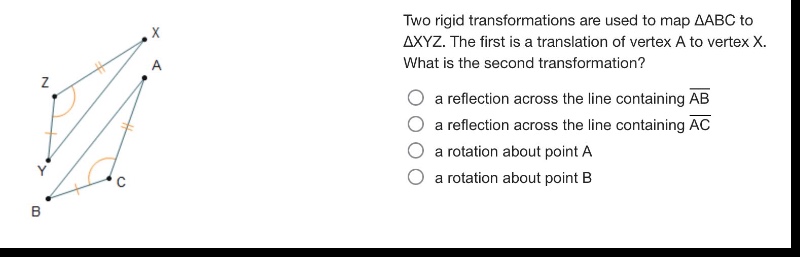
two rigid transformations are used to map △abc to △xyz. the first is a translation of vertex a to vertex x. what is the second transformation? a reflection across the line containing ab a reflection across the line containing ac a rotation about point a a rotation about point b
Answer
Brief Explanations:
After translating vertex A to vertex X, to map the rest of the triangle, a rotation about point A will align the sides and angles of $\triangle ABC$ with $\triangle XYZ$ as the orientation needs to be adjusted. A reflection across the lines containing $\overline{AB}$ or $\overline{AC}$ won't achieve the mapping as the orientation is wrong for a reflection - type transformation here. Rotation about point B won't work as the initial alignment is made with A - X translation and the center of rotation should be the point that was translated (A).
Answer:
a rotation about point A