two rigid transformations are used to map △hjk to △lmn. the first is a translation of vertex h to vertex l…
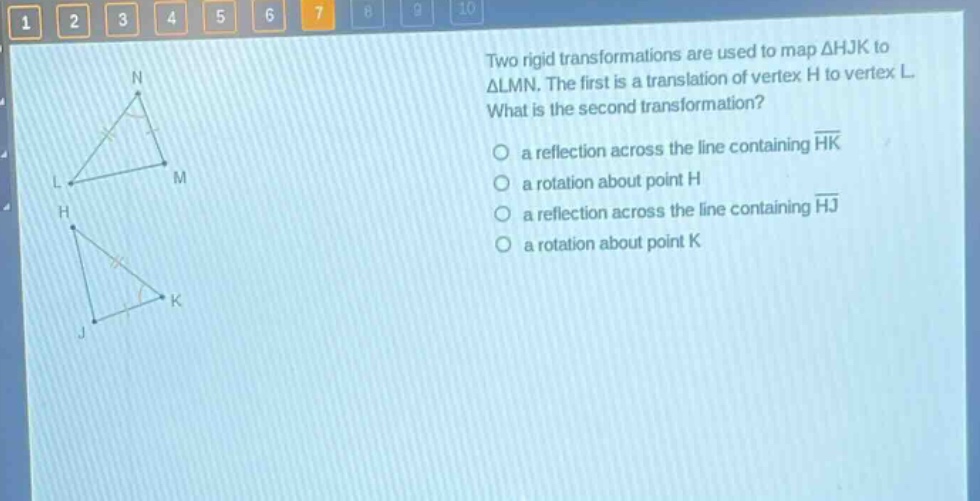
two rigid transformations are used to map △hjk to △lmn. the first is a translation of vertex h to vertex l. what is the second transformation?\n a reflection across the line containing hk\n a rotation about point h\n a reflection across the line containing hj\n a rotation about point k
Answer
Brief Explanations:
A translation moves the triangle so that one vertex (H to L). To align the rest of the triangle's orientation with ΔLMN, a rotation about the point that was translated (point H) is a common rigid - transformation. A reflection across a line containing a side of the triangle would change the orientation in a different way than what is typically needed after a translation to map one triangle to another in this context. Rotation about point K would not be the correct follow - up to the translation of H to L.
Answer:
a rotation about point H