tyler applied the change of base formula to a logarithmic expression. the resulting expression is shown…
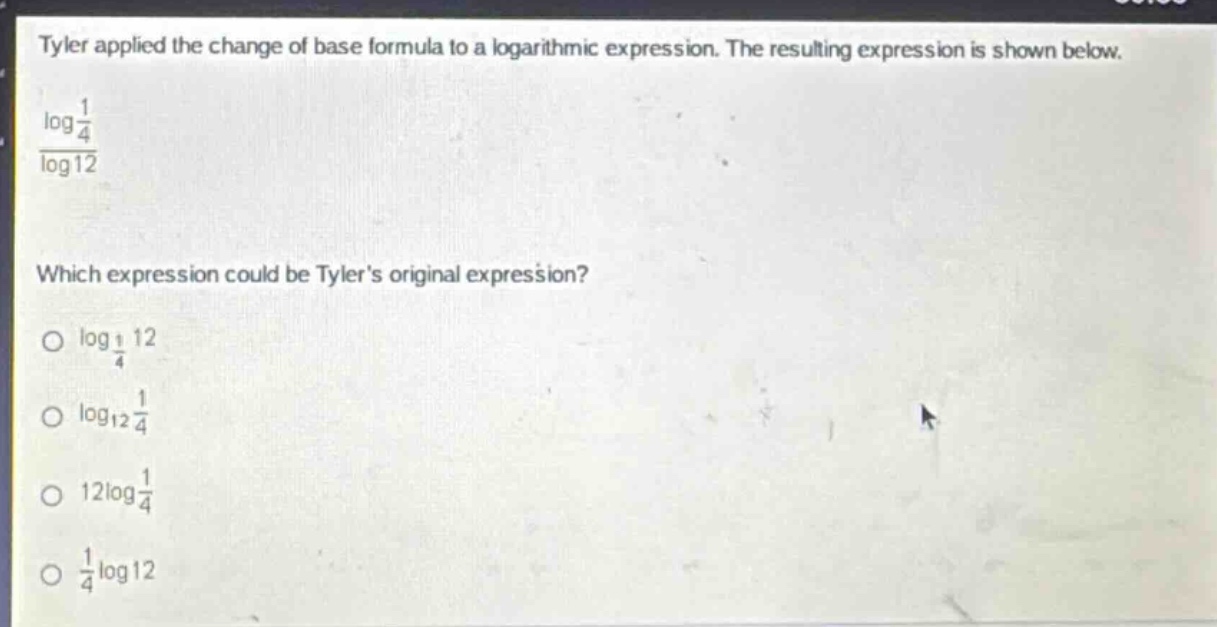
tyler applied the change of base formula to a logarithmic expression. the resulting expression is shown below.\n\\(\\frac{\\log\\frac{1}{4}}{\\log12}\\)\nwhich expression could be tylers original expression?\n\\(\\log_{\\frac{1}{4}}12\\)\n\\(\\log_{12}\\frac{1}{4}\\)\n\\(12\\log\\frac{1}{4}\\)\n\\(\\frac{1}{4}\\log12\\)
Answer
Explanation:
Step1: Recall change - of - base formula
The change - of - base formula for logarithms is $\log_{a}b=\frac{\log_{c}b}{\log_{c}a}$, where $c>0,c\neq1$.
Step2: Identify the values of $a$, $b$ and $c$
In the given expression $\frac{\log\frac{1}{4}}{\log12}$, comparing with the change - of - base formula $\frac{\log_{c}b}{\log_{c}a}$, we have $c$ as the common base of the numerator and denominator logarithms (usually base 10 if no base is written), $b = \frac{1}{4}$ and $a = 12$.
Step3: Write the original logarithm
By the change - of - base formula, the original logarithm is $\log_{12}\frac{1}{4}$.
Answer:
$\log_{12}\frac{1}{4}$ (corresponding to the second option in the multiple - choice list)