type the correct answer in each box. solve the equation, and enter the solutions from least to greatest. if…
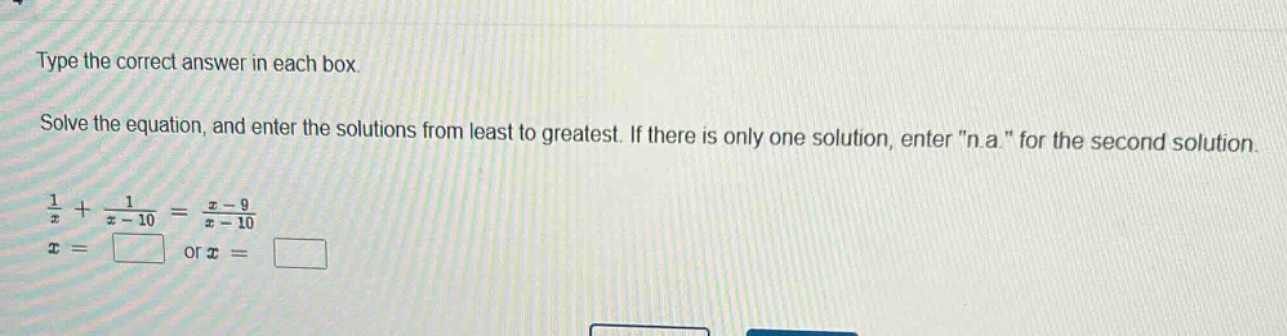
type the correct answer in each box. solve the equation, and enter the solutions from least to greatest. if there is only one solution, enter \n.a.\ for the second solution. $\frac{1}{x}+\frac{1}{x - 10}=\frac{x - 9}{x - 10}$ $x=square$ or $x=square$
Answer
Explanation:
Step1: Find common denominator
The common denominator of the left - hand side is $x(x - 10)$. So we rewrite the left - hand side as $\frac{x-10+x}{x(x - 10)}=\frac{2x - 10}{x(x - 10)}$. The right - hand side is $\frac{x - 9}{x - 10}$.
Step2: Cross - multiply
Since $\frac{2x - 10}{x(x - 10)}=\frac{x - 9}{x - 10}$, cross - multiplying gives $(2x - 10)(x - 10)=x(x - 9)(x - 10)$ (note $x\neq10$). Canceling out $(x - 10)$ on both sides (for $x\neq10$), we get $2x-10=x(x - 9)$.
Step3: Expand and rearrange
Expand $2x-10=x^2-9x$ to $x^2-9x-2x + 10=0$, which simplifies to $x^2-11x + 10=0$.
Step4: Factor the quadratic equation
Factor $x^2-11x + 10$ as $(x - 1)(x - 10)=0$.
Step5: Solve for x
Setting each factor equal to zero gives $x-1=0$ or $x - 10=0$. But $x = 10$ is an extraneous solution (because it makes the original denominators zero). So $x=1$.
Answer:
$x = 1$ or $x=n.a.$