type the correct answer in each box. use numerals instead of words. consider the quadratic equation…
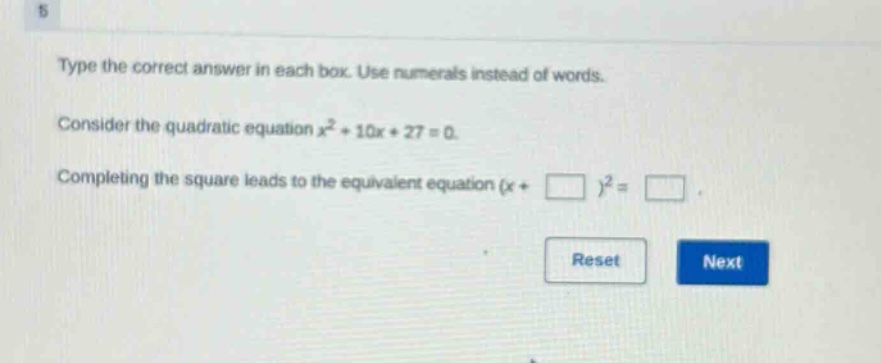
type the correct answer in each box. use numerals instead of words. consider the quadratic equation $x^{2}+10x + 27 = 0$. completing the square leads to the equivalent equation $(x+square)^{2}=square$.
Answer
Explanation:
Step1: Recall the formula for completing the square
For a quadratic equation of the form $x^{2}+bx + c=0$, to complete the square we use $(x+\frac{b}{2})^{2}=x^{2}+bx+\frac{b^{2}}{4}$. In the given equation $x^{2}+10x + 27=0$, where $b = 10$.
Step2: Rewrite the left - hand side of the equation
First, for the $x^{2}+10x$ part, we know that $x^{2}+10x=(x + 5)^{2}-25$ (since $\frac{b}{2}=\frac{10}{2}=5$ and $(x + 5)^{2}=x^{2}+10x + 25$). So the original equation $x^{2}+10x+27 = 0$ can be rewritten as $(x + 5)^{2}-25+27=0$.
Step3: Simplify the equation
Simplify $(x + 5)^{2}-25+27=0$ to get $(x + 5)^{2}+2=0$, then $(x + 5)^{2}=-2$.
Answer:
5, - 2