the unit price of strawberries at a local fruit stand is \\$3.29 per pound for quantities of berries…
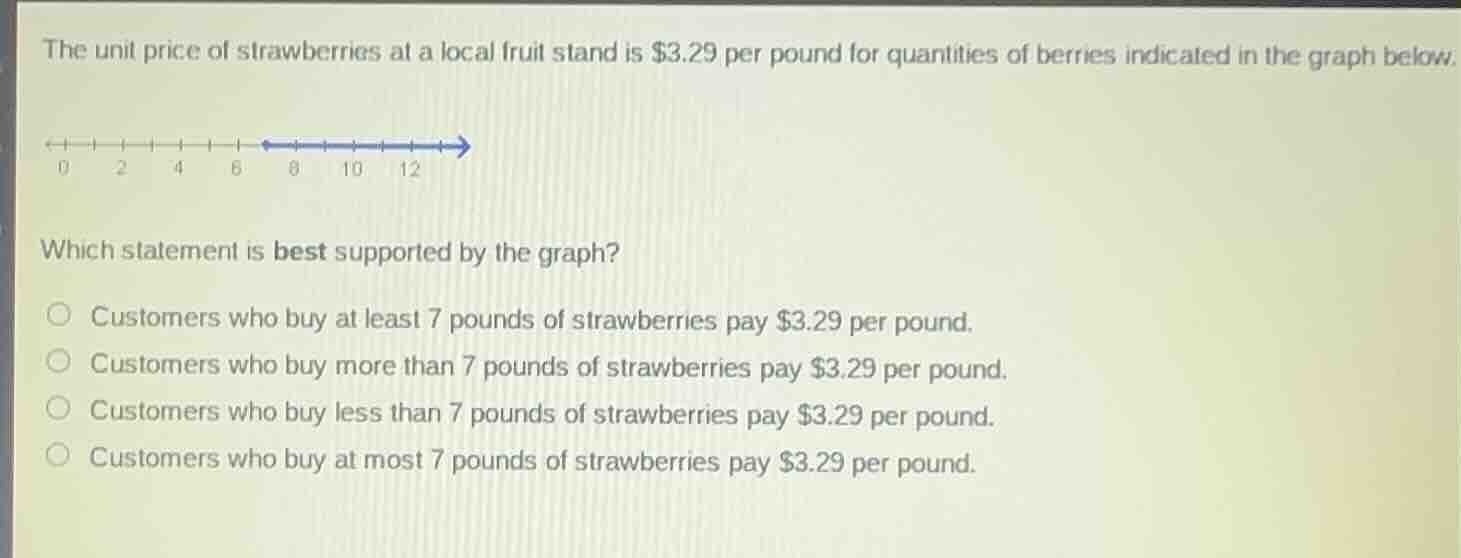
the unit price of strawberries at a local fruit stand is \\$3.29 per pound for quantities of berries indicated in the graph below.\n\nwhich statement is best supported by the graph?\n\n- customers who buy at least 7 pounds of strawberries pay \\$3.29 per pound.\n- customers who buy more than 7 pounds of strawberries pay \\$3.29 per pound.\n- customers who buy less than 7 pounds of strawberries pay \\$3.29 per pound.\n- customers who buy at most 7 pounds of strawberries pay \\$3.29 per pound.
Answer
Explanation:
Step1: Identify the starting point on the number line
The blue ray begins at the number $7$.
Step2: Determine the type of endpoint
The circle at $7$ is solid (filled in), which indicates that $7$ is included in the set.
Step3: Determine the direction of the ray
The ray points to the right, representing values greater than $7$.
Step4: Combine the findings into an inequality
The graph represents the inequality $x \ge 7$.
Step5: Translate the inequality into verbal terms
The phrase "at least 7" corresponds to the mathematical expression "greater than or equal to 7".
Answer:
Customers who buy at least 7 pounds of strawberries pay $3.29 per pound.