9. use a double - angle formula and the figure below to find the exact value of tan2θ.\nchapter 6.3…
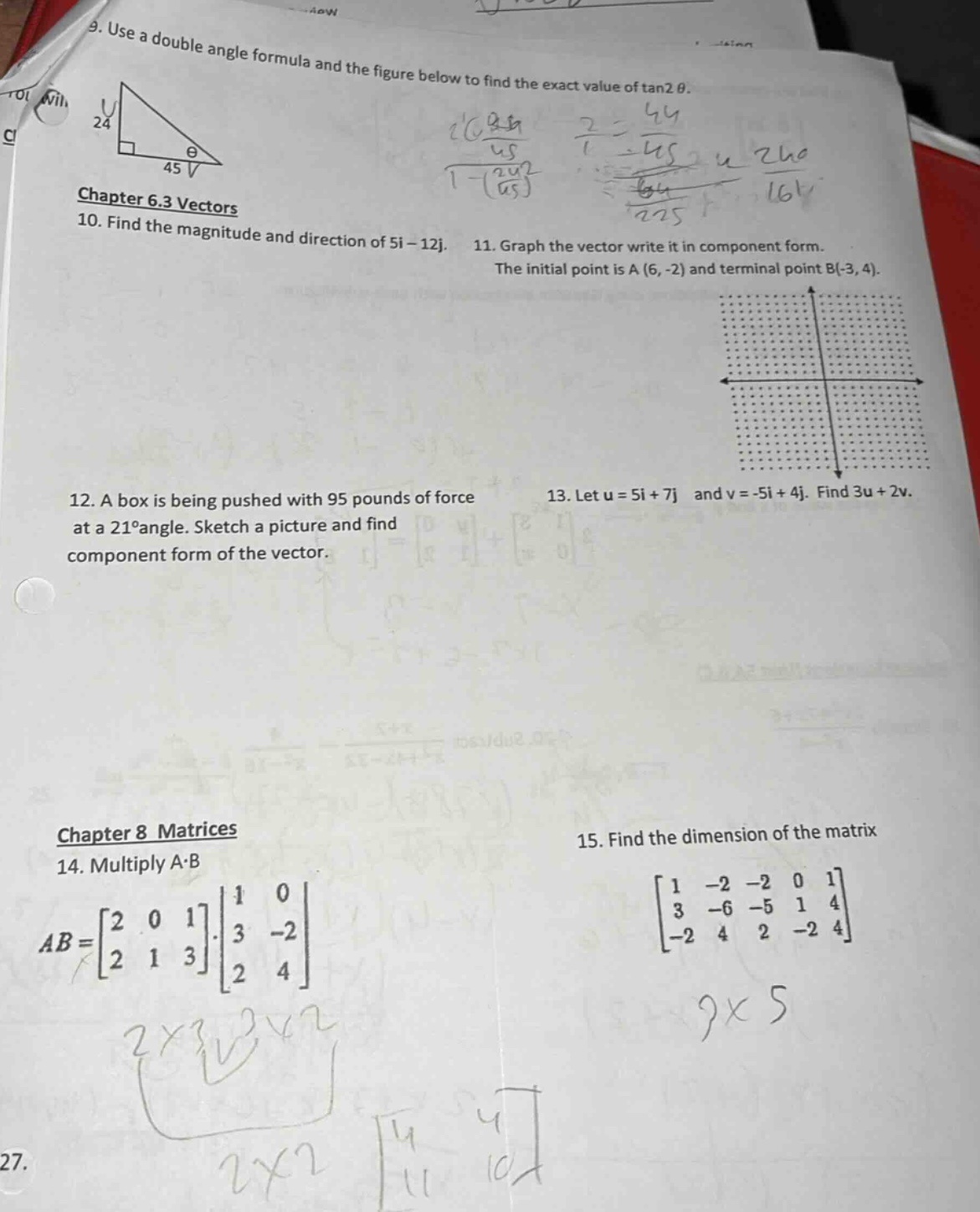
9. use a double - angle formula and the figure below to find the exact value of tan2θ.\nchapter 6.3 vectors\n10. find the magnitude and direction of 5i - 12j.\n11. graph the vector write it in component form. the initial point is a(6, - 2) and terminal point b(-3, 4).\n12. a box is being pushed with 95 pounds of force at a 21°angle. sketch a picture and find component form of the vector.\n13. let u = 5i + 7j and v=-5i + 4j. find 3u + 2v.\nchapter 8 matrices\n14. multiply a·b\nab = \\(\\begin{bmatrix}2&0&1\\\\2&1&3\\end{bmatrix}\\cdot\\begin{bmatrix}1&0\\\\3&-2\\\\2&4\\end{bmatrix}\\)\n15. find the dimension of the matrix \\(\\begin{bmatrix}1&-2&-2&0&1\\\\3&-6&-5&1&4\\\\-2&4&2&-2&4\\end{bmatrix}\\)
Answer
9.
Explanation:
Step1: Find $\tan\theta$
In the right - triangle, $\tan\theta=\frac{24}{45}=\frac{8}{15}$
Step2: Apply double - angle formula for tangent
The double - angle formula for tangent is $\tan2\theta=\frac{2\tan\theta}{1 - \tan^{2}\theta}$. Substitute $\tan\theta=\frac{8}{15}$ into the formula: [ \begin{align*} \tan2\theta&=\frac{2\times\frac{8}{15}}{1-(\frac{8}{15})^{2}}\ &=\frac{\frac{16}{15}}{1-\frac{64}{225}}\ &=\frac{\frac{16}{15}}{\frac{225 - 64}{225}}\ &=\frac{\frac{16}{15}}{\frac{161}{225}}\ &=\frac{16}{15}\times\frac{225}{161}\ &=\frac{16\times15}{161}\ &=\frac{240}{161} \end{align*} ]
Answer:
$\frac{240}{161}$
10.
Explanation:
Step1: Find the magnitude of the vector $\vec{v}=5\vec{i}-12\vec{j}$
The magnitude of a vector $\vec{v}=a\vec{i}+b\vec{j}$ is given by $|\vec{v}|=\sqrt{a^{2}+b^{2}}$. Here, $a = 5$ and $b=-12$, so $|\vec{v}|=\sqrt{5^{2}+(-12)^{2}}=\sqrt{25 + 144}=\sqrt{169}=13$
Step2: Find the direction of the vector
The direction $\theta$ of the vector $\vec{v}=a\vec{i}+b\vec{j}$ is given by $\tan\theta=\frac{b}{a}$. So, $\tan\theta=\frac{-12}{5}$, and since $a = 5>0$ and $b=-12<0$, the vector lies in the fourth quadrant. $\theta=\arctan(-\frac{12}{5})\approx - 67.38^{\circ}+360^{\circ}\approx292.62^{\circ}$
Answer:
Magnitude: 13; Direction: approximately $292.62^{\circ}$
11.
Explanation:
Step1: Find the component form of the vector
If the initial point is $A(x_1,y_1)=(6,-2)$ and the terminal point is $B(x_2,y_2)=(-3,4)$, then the component form of the vector $\overrightarrow{AB}=\langle x_2 - x_1,y_2 - y_1\rangle=\langle-3 - 6,4+2\rangle=\langle - 9,6\rangle$
Step2: Graph the vector
Start at the point $(6,-2)$ and move 9 units to the left and 6 units up to reach the point $(-3,4)$.
Answer:
Component form: $\langle - 9,6\rangle$
12.
Explanation:
Step1: Sketch the picture
Draw a coordinate system. Represent the force vector with its tail at the origin. The angle between the vector and the positive $x$ - axis is $21^{\circ}$ and the length of the vector (magnitude of the force) is 95 pounds.
Step2: Find the component form of the vector
If the magnitude of the vector is $F = 95$ and the angle is $\theta=21^{\circ}$, then the component form of the vector $\vec{F}=\langle F\cos\theta,F\sin\theta\rangle$. So, $\vec{F}=\langle95\cos21^{\circ},95\sin21^{\circ}\rangle\approx\langle95\times0.934,95\times0.358\rangle=\langle88.73,34.01\rangle$
Answer:
Component form: $\langle88.73,34.01\rangle$
13.
Explanation:
Step1: Calculate $3\vec{u}$ and $2\vec{v}$
Given $\vec{u}=5\vec{i}+7\vec{j}$ and $\vec{v}=-5\vec{i}+4\vec{j}$. Then $3\vec{u}=3(5\vec{i}+7\vec{j}) = 15\vec{i}+21\vec{j}$ and $2\vec{v}=2(-5\vec{i}+4\vec{j})=-10\vec{i}+8\vec{j}$
Step2: Find $3\vec{u}+2\vec{v}$
$3\vec{u}+2\vec{v}=(15\vec{i}+21\vec{j})+(-10\vec{i}+8\vec{j})=(15 - 10)\vec{i}+(21 + 8)\vec{j}=5\vec{i}+29\vec{j}$
Answer:
$5\vec{i}+29\vec{j}$
14.
Explanation:
Step1: Check if the matrices are multiplicable
Matrix $A$ is a $2\times3$ matrix and matrix $B$ is a $3\times2$ matrix. Since the number of columns in $A$ (3) is equal to the number of rows in $B$ (3), the product $AB$ is defined.
Step2: Calculate the product
[ \begin{align*} AB&=\left[\begin{array}{ccc}2&0&1\2&1&3\end{array}\right]\left[\begin{array}{cc}1&0\3&-2\2&4\end{array}\right]\ &=\left[\begin{array}{cc}2\times1+0\times3 + 1\times2&2\times0+0\times(-2)+1\times4\2\times1+1\times3+3\times2&2\times0+1\times(-2)+3\times4\end{array}\right]\ &=\left[\begin{array}{cc}2 + 0+2&0 + 0+4\2+3 + 6&0-2 + 12\end{array}\right]\ &=\left[\begin{array}{cc}4&4\11&10\end{array}\right] \end{align*} ]
Answer:
$\left[\begin{array}{cc}4&4\11&10\end{array}\right]$
15.
Explanation:
The dimension of a matrix is given by the number of rows and columns. The given matrix has 3 rows and 5 columns.
Answer:
$3\times5$