use the drawing tool(s) to form the correct answer on the provided graph. plot the x - intercept(s), y…
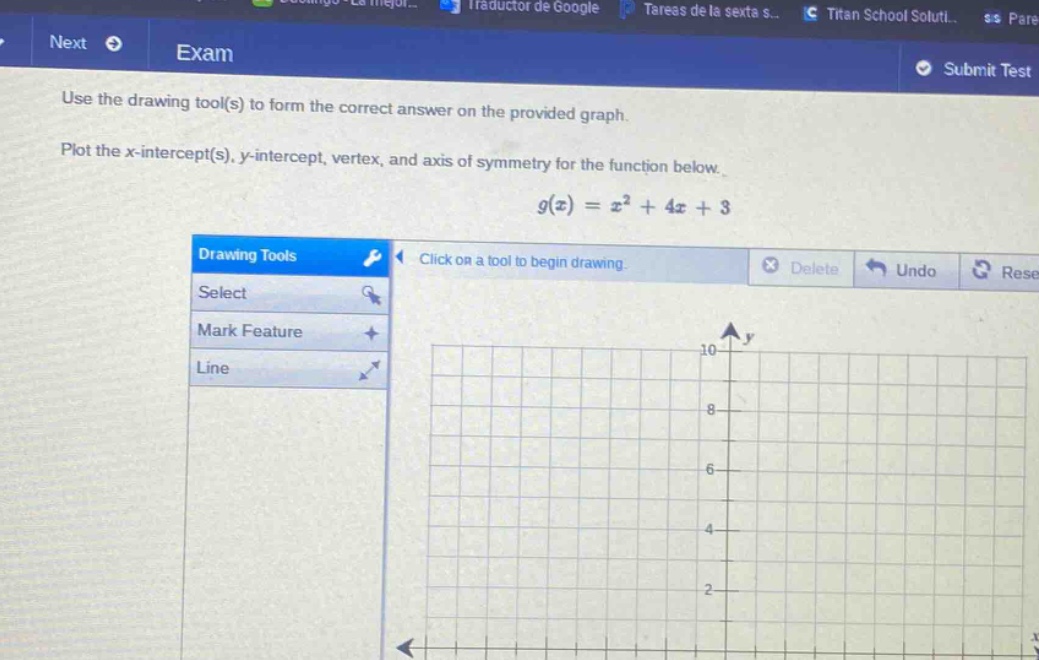
use the drawing tool(s) to form the correct answer on the provided graph. plot the x - intercept(s), y - intercept, vertex, and axis of symmetry for the function below. $g(x)=x^{2}+4x + 3$
Answer
Explanation:
Step1: Encontrar el intercepto en y
Sustituir (x = 0) en (g(x)). [g(0)=0^{2}+4\times0 + 3=3] El intercepto en (y) es el punto ((0,3)).
Step2: Encontrar los interceptos en x
Igualar (g(x)=0), es decir (x^{2}+4x + 3=0). Factorizar: ((x + 1)(x+3)=0). Entonces (x+1 = 0) o (x + 3=0), lo que da (x=-1) y (x=-3). Los interceptos en (x) son los puntos ((-1,0)) y ((-3,0)).
Step3: Encontrar el vértice
Para una función (y = ax^{2}+bx + c) (aquí (a = 1), (b = 4), (c = 3)), la coordenada (x) del vértice se calcula como (x=-\frac{b}{2a}). [x=-\frac{4}{2\times1}=-2] Sustituir (x=-2) en (g(x)): (g(-2)=(-2)^{2}+4\times(-2)+3=4 - 8+3=-1). El vértice es el punto ((-2,-1)).
Step4: Encontrar el eje de simetría
El eje de simetría de una parábola (y = ax^{2}+bx + c) es la recta (x=-\frac{b}{2a}). Como (x = - 2) es la coordenada (x) del vértice, el eje de simetría es la recta (x=-2).
Answer:
Intercepto en (y): ((0,3)); Interceptos en (x): ((-1,0)) y ((-3,0)); Vértice: ((-2,-1)); Eje de simetría: (x=-2)