use the drop - down menus to complete the proof of the pythagorean theorem using the figures. click the…
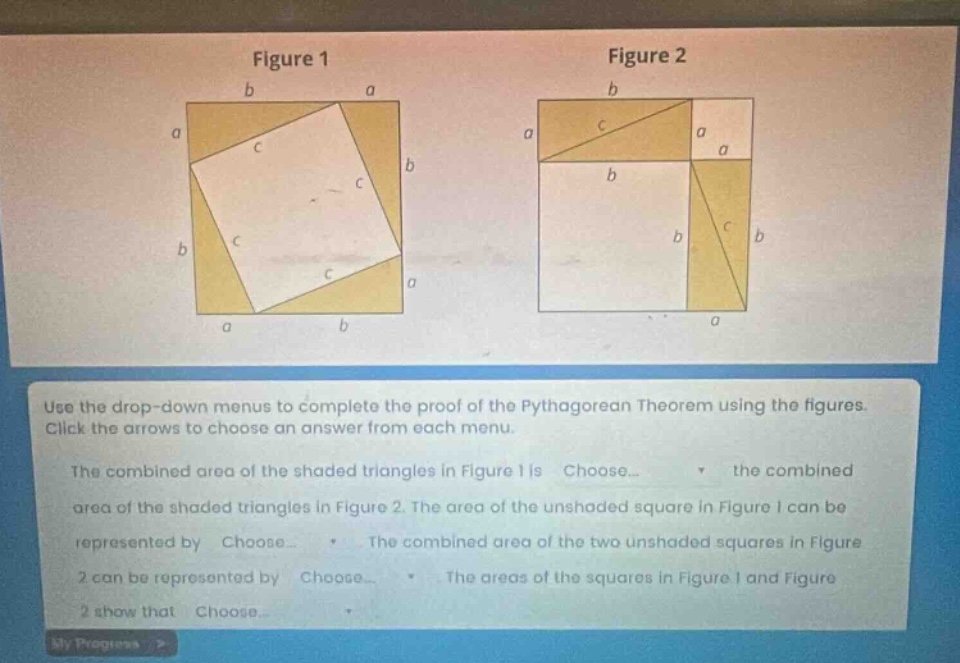
use the drop - down menus to complete the proof of the pythagorean theorem using the figures. click the arrows to choose an answer from each menu. the combined area of the shaded triangles in figure 1 is choose... the combined area of the shaded triangles in figure 2. the area of the unshaded square in figure 1 can be represented by choose... the combined area of the two unshaded squares in figure 2 can be represented by choose... the areas of the squares in figure 1 and figure 2 show that choose...
Answer
Explanation:
Step1: Calculate area of shaded triangles in Figure 1
There are 4 right - angled triangles with legs (a) and (b). The area of one right - angled triangle is (\frac{1}{2}ab), so the combined area of 4 triangles is (4\times\frac{1}{2}ab = 2ab).
Step2: Calculate area of shaded triangles in Figure 2
There are also 4 right - angled triangles with legs (a) and (b). The combined area of these 4 triangles is (4\times\frac{1}{2}ab=2ab). So the combined area of the shaded triangles in Figure 1 is equal to the combined area of the shaded triangles in Figure 2.
Step3: Find area of unshaded square in Figure 1
The side length of the unshaded square in Figure 1 is (c), so its area is (c^{2}).
Step4: Find combined area of unshaded squares in Figure 2
The side lengths of the two unshaded squares in Figure 2 are (a) and (b) respectively. The combined area of the two unshaded squares is (a^{2}+b^{2}).
Step5: Prove Pythagorean Theorem
Since the total area of the large square in both figures is the same and the area of the shaded parts is the same, we have (a^{2}+b^{2}=c^{2}).
Answer:
The combined area of the shaded triangles in Figure 1 is equal to the combined area of the shaded triangles in Figure 2. The area of the unshaded square in Figure 1 can be represented by (c^{2}). The combined area of the two unshaded squares in Figure 2 can be represented by (a^{2}+b^{2}). The areas of the squares in Figure 1 and Figure 2 show that (a^{2}+b^{2}=c^{2}).