use synthetic division to solve $(x^{3}-x^{2}-17x - 15)div(x - 5)$. what is the quotient?\n$x^{2}+4x +…
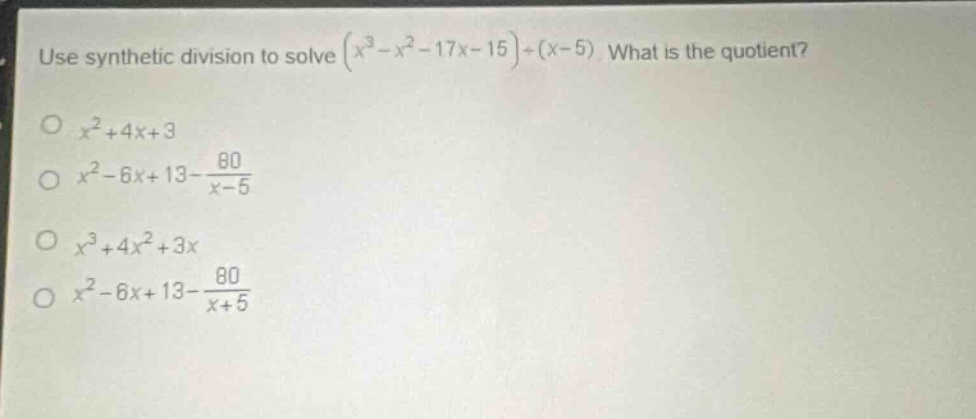
use synthetic division to solve $(x^{3}-x^{2}-17x - 15)div(x - 5)$. what is the quotient?\n$x^{2}+4x + 3$\n$x^{2}-6x + 13-\frac{80}{x - 5}$\n$x^{3}+4x^{2}+3x$\n$x^{2}-6x + 13-\frac{80}{x + 5}$
Answer
Explanation:
Step1: Set up synthetic division
The divisor is (x - 5), so we use (c = 5). The dividend coefficients are (1,-1,-17,-15).
Step2: Bring down the first coefficient
Bring down the first coefficient (1).
| 5 | 1 | -1 | -17 | -15 |
|---|---|---|---|---|
| 1 |
Step3: Multiply and add
Multiply (5\times1 = 5), add to the second - coefficient: (-1+5 = 4).
| 5 | 1 | -1 | -17 | -15 |
|---|---|---|---|---|
| 5 | ||||
| 1 | 4 |
Step4: Multiply and add again
Multiply (5\times4 = 20), add to the third - coefficient: (-17 + 20=3).
| 5 | 1 | -1 | -17 | -15 |
|---|---|---|---|---|
| 5 | 20 | |||
| 1 | 4 | 3 |
Step5: Multiply and add one more time
Multiply (5\times3 = 15), add to the fourth - coefficient: (-15+15 = 0).
| 5 | 1 | -1 | -17 | -15 |
|---|---|---|---|---|
| 5 | 20 | 15 | ||
| 1 | 4 | 3 | 0 |
The numbers (1,4,3) are the coefficients of the quotient polynomial. The quotient is (x^{2}+4x + 3).
Answer:
A. (x^{2}+4x + 3)