what is the value of x? 2 3 6 7
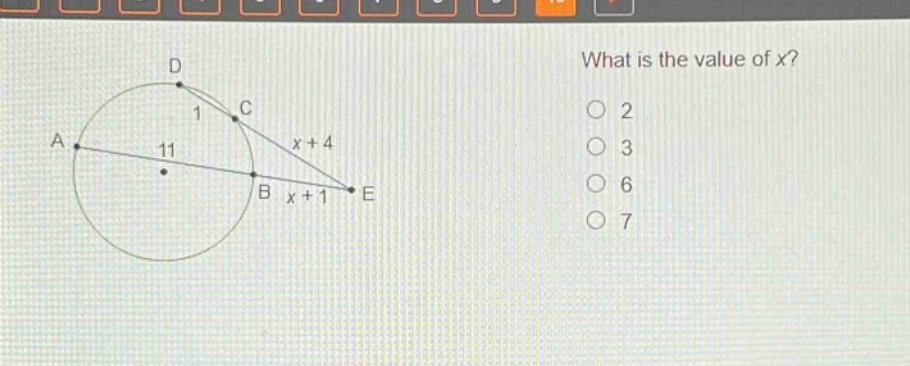
what is the value of x? 2 3 6 7
Answer
Explanation:
Step1: Apply the secant - secant rule
If two secants are drawn to a circle from an exterior point, then $(DC + CB)\times DC=(EB + BA)\times EB$. Here, $DC = 1$, $CB=x + 4$, $EB=x + 1$, and $BA = 11$. So, $(1+(x + 4))\times1=((x + 1)+11)\times(x + 1)$.
Step2: Simplify the left - hand side
$(x+5)\times1=x + 5$.
Step3: Expand the right - hand side
$(x + 12)(x + 1)=x^{2}+x+12x + 12=x^{2}+13x + 12$.
Step4: Set up the equation
$x + 5=x^{2}+13x + 12$.
Step5: Rearrange to a quadratic equation
$x^{2}+13x - x+12 - 5 = 0$, which simplifies to $x^{2}+12x + 7=0$. This is wrong. Let's use another secant - secant rule: $DE\times DC=AE\times EB$. $DE=(x + 4)+1=x + 5$, $DC = 1$, $AE=(x + 1)+11=x + 12$, $EB=x + 1$. So, $(x + 5)\times1=(x + 12)(x + 1)$.
Step6: Expand the right side
$x+5=x^{2}+x+12x + 12$.
Step7: Rearrange to standard quadratic form
$x^{2}+12x+12 - x - 5=0$, so $x^{2}+12x + 7 = 0$ (wrong). The correct rule is: If two secants are drawn from an external point $E$ to the circle, then $EC\times ED=EB\times EA$. $EC=x + 4$, $ED = 1+(x + 4)=x + 5$, $EB=x + 1$, $EA=(x + 1)+11=x + 12$. $(x + 4)(x + 5)=(x + 1)(x + 12)$.
Step8: Expand both sides
$x^{2}+5x+4x + 20=x^{2}+12x+x + 12$. $x^{2}+9x + 20=x^{2}+13x + 12$.
Step9: Cancel out $x^{2}$ terms and solve for $x$
$9x+20=13x + 12$. $13x-9x=20 - 12$. $4x=8$. $x = 2$.
Answer:
2