what is the value of u? u =
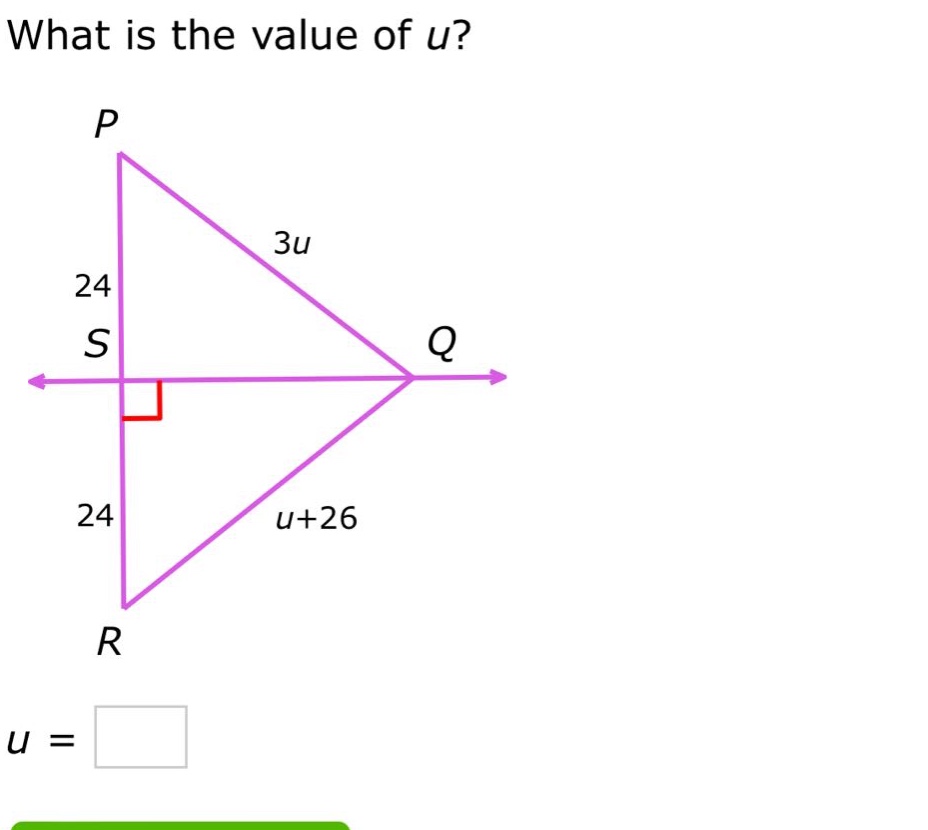
what is the value of u? u =
Answer
Answer:
13
Explanation:
Step1: Apply Pythagorean theorem
In right - triangle $PSQ$, by Pythagorean theorem, $PQ^{2}=PS^{2}+SQ^{2}$. In right - triangle $RSQ$, $RQ^{2}=RS^{2}+SQ^{2}$. Since $PS = RS=24$, we can set up the equation based on the fact that if we consider the two right - triangles sharing the same height $SQ$ and the hypotenuses $PQ = 3u$ and $RQ=u + 26$. According to the Pythagorean theorem, we have $(3u)^{2}-24^{2}=(u + 26)^{2}-24^{2}$.
Step2: Simplify the equation
$(3u)^{2}=(u + 26)^{2}$. Expanding, we get $9u^{2}=u^{2}+52u + 676$.
Step3: Rearrange to a quadratic equation
$9u^{2}-u^{2}-52u - 676 = 0$, which simplifies to $8u^{2}-52u-676 = 0$. Divide through by 4: $2u^{2}-13u - 169 = 0$.
Step4: Solve the quadratic equation
We can use the quadratic formula $x=\frac{-b\pm\sqrt{b^{2}-4ac}}{2a}$ for the quadratic equation $ax^{2}+bx + c = 0$. Here, $a = 2$, $b=-13$, $c=-169$. First, calculate the discriminant $\Delta=b^{2}-4ac=(-13)^{2}-4\times2\times(-169)=169 + 1352 = 1521$. Then, $u=\frac{13\pm\sqrt{1521}}{4}=\frac{13\pm39}{4}$. We get two solutions: $u=\frac{13 + 39}{4}=\frac{52}{4}=13$ and $u=\frac{13-39}{4}=\frac{-26}{4}=-\frac{13}{2}$. Since $u$ represents a length - related value in a geometric context, we discard the negative solution. So $u = 13$.