for what value of n does $\frac{216^{n - 2}}{(\frac{1}{36})^{3n}} = 216$?\n-3\n$-\frac{1}{3}$\n$\frac{5}{9}$\…
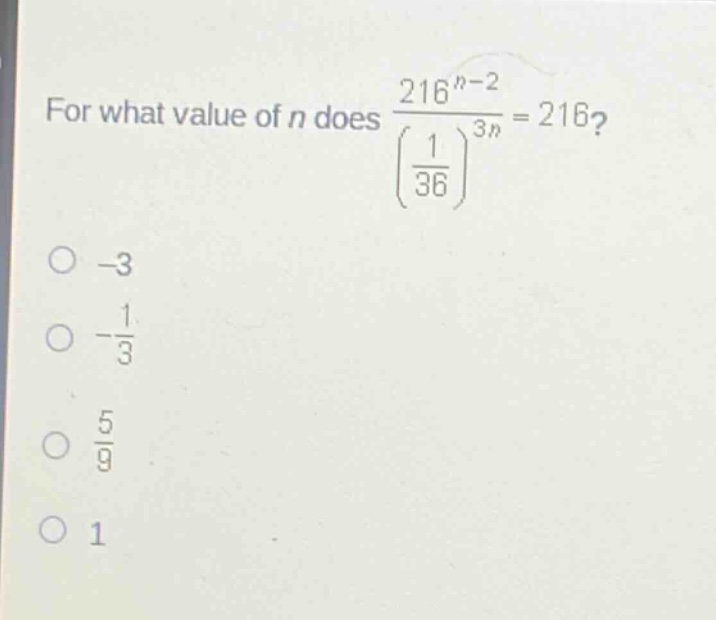
for what value of n does $\frac{216^{n - 2}}{(\frac{1}{36})^{3n}} = 216$?\n-3\n$-\frac{1}{3}$\n$\frac{5}{9}$\n1
Answer
Explanation:
Step1: Rewrite bases as powers of 6
We know that $216 = 6^3$ and $36=6^2$. So, $\frac{216^{n - 2}}{(\frac{1}{36})^{3n}}=\frac{(6^3)^{n - 2}}{(6^{- 2})^{3n}}$.
Step2: Apply power - of - a - power rule
By the power - of - a - power rule $(a^m)^n=a^{mn}$, we have $\frac{(6^3)^{n - 2}}{(6^{- 2})^{3n}}=\frac{6^{3(n - 2)}}{6^{-6n}}$.
Step3: Apply quotient rule of exponents
The quotient rule $\frac{a^m}{a^n}=a^{m - n}$ gives $\frac{6^{3(n - 2)}}{6^{-6n}}=6^{3(n - 2)-(-6n)}$. Expand the exponent: $3(n - 2)-(-6n)=3n-6 + 6n=9n-6$.
Step4: Set the exponent equal to 3
Since $\frac{216^{n - 2}}{(\frac{1}{36})^{3n}} = 216=6^3$, then $9n-6 = 3$.
Step5: Solve for n
Add 6 to both sides of the equation $9n-6 = 3$: $9n=3 + 6=9$. Divide both sides by 9: $n = 1$.
Answer:
1