the a value of a function in the form f(x) = ax² + bx + c is negative. which statement must be true?\no the…
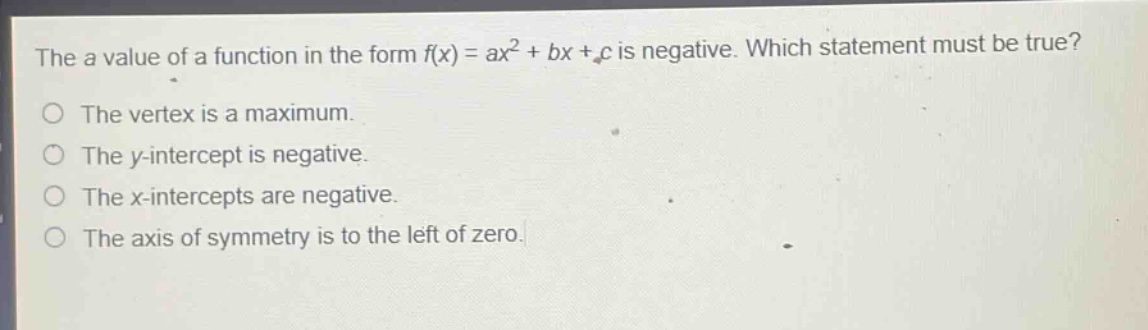
the a value of a function in the form f(x) = ax² + bx + c is negative. which statement must be true?\no the vertex is a maximum.\no the y - intercept is negative.\no the x - intercepts are negative.\no the axis of symmetry is to the left of zero.
Answer
Explanation:
Step1: Recall quadratic - function properties
For a quadratic function (y = ax^{2}+bx + c), the sign of (a) determines the shape of the parabola. If (a<0), the parabola opens downwards.
Step2: Analyze the vertex
When a parabola (y = ax^{2}+bx + c) with (a < 0) opens downwards, the vertex of the parabola is the highest - point on the graph. So the vertex represents a maximum value of the function.
Step3: Analyze the y - intercept
The (y) - intercept is found by setting (x = 0), so (y(0)=c). We only know the sign of (a), not (c), so the (y) - intercept can be positive, negative, or zero.
Step4: Analyze the x - intercepts
The (x) - intercepts are found by solving (ax^{2}+bx + c = 0). The roots (x=\frac{-b\pm\sqrt{b^{2}-4ac}}{2a}). The sign of the roots depends on (a), (b), and (c), not just (a). So the (x) - intercepts can be positive, negative, or a mix.
Step5: Analyze the axis of symmetry
The axis of symmetry is given by the formula (x =-\frac{b}{2a}). The sign of (x =-\frac{b}{2a}) depends on the signs of (a) and (b). Since we only know (a<0) and not the sign of (b), we cannot determine if the axis of symmetry is to the left or right of zero.
Answer:
The vertex is a maximum.