for what value of a does $\\left(\\frac{1}{9}\\right)^{a + 1}=81^{a + 1}\\cdot27^{2 - a}$?\n-4\n-2\n2\n6
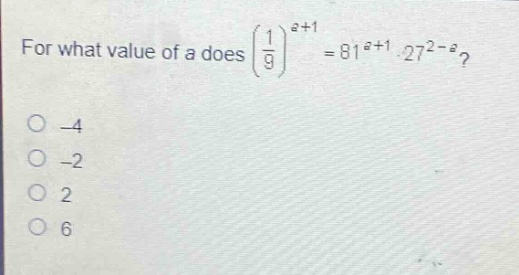
for what value of a does $\\left(\\frac{1}{9}\\right)^{a + 1}=81^{a + 1}\\cdot27^{2 - a}$?\n-4\n-2\n2\n6
Answer
Explanation:
Step1: Rewrite bases as powers of 3
Rewrite $\frac{1}{9}$ as $3^{-2}$, $81$ as $3^{4}$ and $27$ as $3^{3}$. So, $\left(\frac{1}{9}\right)^{a + 1}=(3^{-2})^{a + 1}=3^{-2(a + 1)}$, $81^{a+1}=(3^{4})^{a + 1}=3^{4(a + 1)}$ and $27^{2 - a}=(3^{3})^{2 - a}=3^{3(2 - a)}$.
Step2: Set up the equation
The original equation $\left(\frac{1}{9}\right)^{a + 1}=81^{a + 1}\cdot27^{2 - a}$ becomes $3^{-2(a + 1)}=3^{4(a + 1)}\cdot3^{3(2 - a)}$.
Step3: Use exponent - rule for multiplication
According to the rule $x^{m}\cdot x^{n}=x^{m + n}$, the right - hand side is $3^{4(a + 1)+3(2 - a)}$. So the equation is $3^{-2(a + 1)}=3^{4(a + 1)+3(2 - a)}$.
Step4: Equate the exponents
Since the bases are the same, we can equate the exponents: $-2(a + 1)=4(a + 1)+3(2 - a)$.
Step5: Expand and simplify
Expand the equation: $-2a-2 = 4a+4 + 6-3a$. Combine like terms: $-2a-2=a + 10$.
Step6: Solve for a
Add $2a$ to both sides: $-2=a + 10+2a$. Then $-2=3a + 10$. Subtract 10 from both sides: $-2-10=3a$, so $-12 = 3a$. Divide both sides by 3: $a=-4$.
Answer:
-4