for what values of m does the graph of y = 3x² + 7x + m have two x - intercepts?\n○ m > 25/3\n○ m < 25/3\n○…
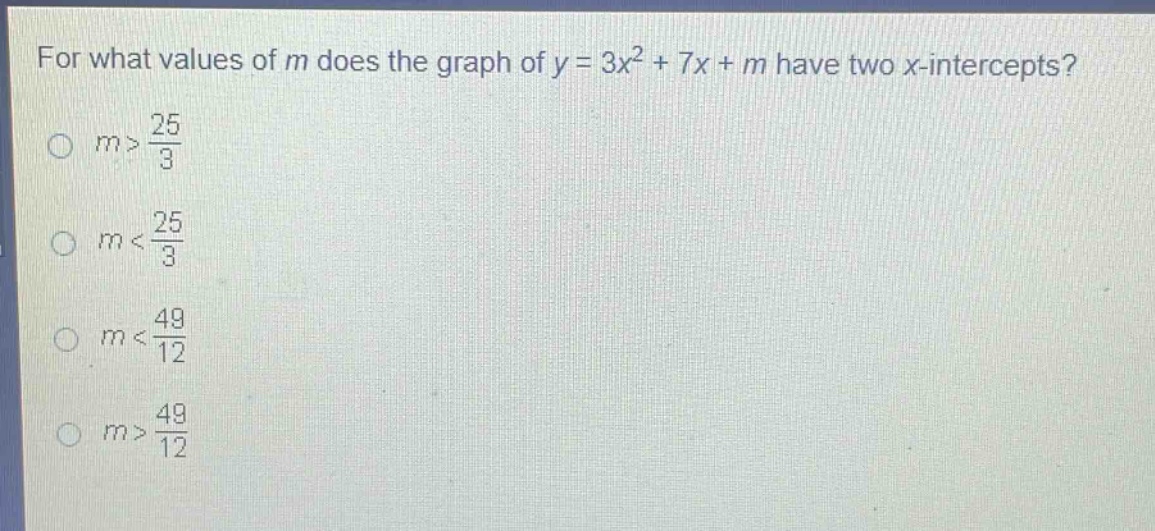
for what values of m does the graph of y = 3x² + 7x + m have two x - intercepts?\n○ m > 25/3\n○ m < 25/3\n○ m < 49/12\n○ m > 49/12
Answer
Explanation:
Step1: Recall the discriminant formula
For a quadratic equation $ax^{2}+bx + c=0$ (in our case, $y = 3x^{2}+7x + m$ corresponds to $3x^{2}+7x + m=0$ where $a = 3$, $b = 7$, $c = m$), the discriminant $\Delta=b^{2}-4ac$.
Step2: Determine the condition for two x - intercepts
A quadratic function has two x - intercepts when $\Delta>0$. So we set up the inequality $b^{2}-4ac>0$. Substitute $a = 3$, $b = 7$, $c = m$ into the inequality: $7^{2}-4\times3\times m>0$.
Step3: Simplify the inequality
First, calculate $7^{2}=49$. The inequality becomes $49 - 12m>0$.
Step4: Solve the inequality for m
Subtract 49 from both sides: $- 12m>-49$. Then divide both sides by - 12. When dividing an inequality by a negative number, the direction of the inequality sign changes. So $m<\frac{49}{12}$.
Answer:
$m<\frac{49}{12}$