what values of c and d make the equation true?\n\\(\\sqrt3{162x^{c}y^{5}} = 3x^{2}y(\\sqrt3{6y^{d}})\\)\n\\(c…
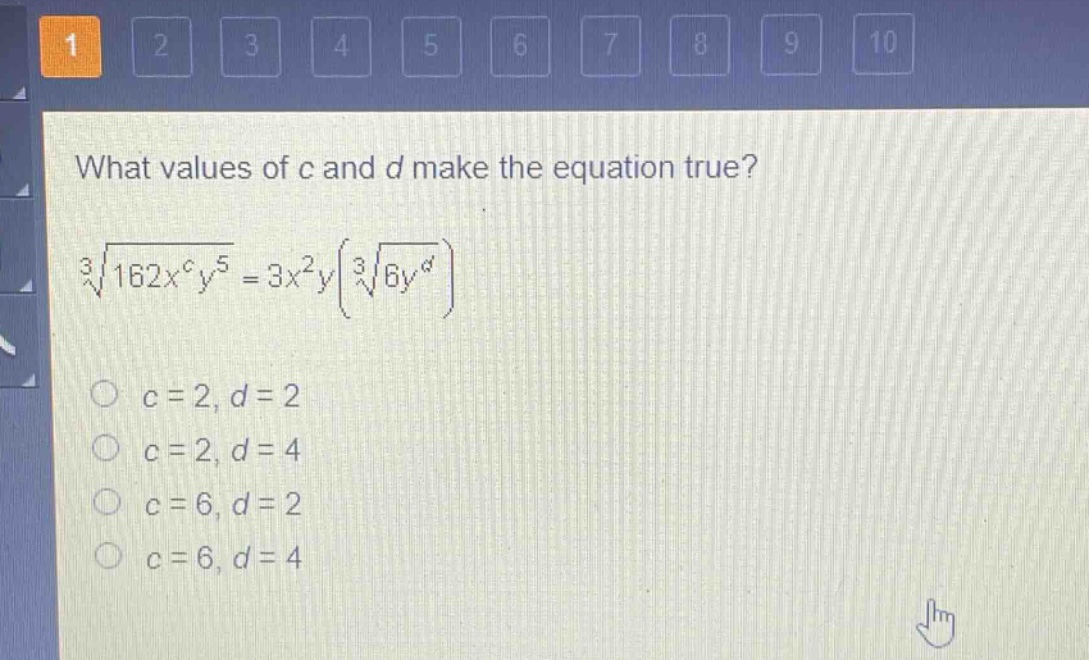
what values of c and d make the equation true?\n\\(\\sqrt3{162x^{c}y^{5}} = 3x^{2}y(\\sqrt3{6y^{d}})\\)\n\\(c = 2, d = 2\\)\n\\(c = 2, d = 4\\)\n\\(c = 6, d = 2\\)\n\\(c = 6, d = 4\\)
Answer
Explanation:
Step1: Cube - both sides of the equation
[(\sqrt[3]{162x^{c}y^{5}})^3=(3x^{2}y\sqrt[3]{6y^{d}})^3] [162x^{c}y^{5}=(3x^{2}y)^3\times( \sqrt[3]{6y^{d}})^3]
Step2: Expand the right - hand side
[(3x^{2}y)^3\times( \sqrt[3]{6y^{d}})^3 = 3^{3}x^{2\times3}y^{3}\times6y^{d}] [=27x^{6}y^{3}\times6y^{d}=162x^{6}y^{3 + d}]
Step3: Compare the exponents of x and y
For the exponents of x: (c = 6) For the exponents of y: (5=3 + d), then (d=5 - 3=2)
Answer:
c = 6, d = 2