what values of c and d make the equation true?\n$sqrt3{162x^{c}y^{5}} = 3x^{2}yleft(sqrt3{6y^{d}}\right)$\n$c…
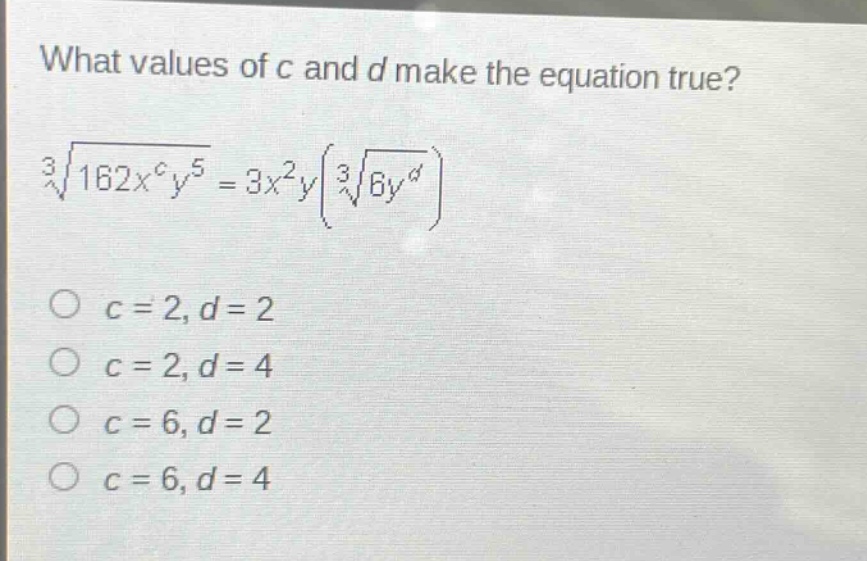
what values of c and d make the equation true?\n$sqrt3{162x^{c}y^{5}} = 3x^{2}yleft(sqrt3{6y^{d}}\right)$\n$c = 2, d = 2$\n$c = 2, d = 4$\n$c = 6, d = 2$\n$c = 6, d = 4$
Answer
Explanation:
Step1: Simplify the left - hand side
First, factor 162: $162=2\times3^4$. So, $\sqrt[3]{162x^{c}y^{5}}=\sqrt[3]{2\times3^4x^{c}y^{5}} = 3\sqrt[3]{6x^{c}y^{5}}$.
Step2: Apply the cube - root property
We know that $\sqrt[3]{a\times b}=\sqrt[3]{a}\times\sqrt[3]{b}$. So, $3\sqrt[3]{6x^{c}y^{5}}=3x^{\frac{c}{3}}y^{\frac{5}{3}}\sqrt[3]{6}$. The right - hand side is $3x^{2}y\sqrt[3]{6y^{d}}$.
Step3: Equate the exponents of x
Equating the exponents of $x$: $\frac{c}{3}=2$. Solving for $c$, we multiply both sides by 3, so $c = 6$.
Step4: Equate the exponents of y
Equating the exponents of $y$: $\frac{5}{3}=1+\frac{d}{3}$. Subtract 1 from both sides: $\frac{5}{3}-1=\frac{d}{3}$. Since $\frac{5}{3}-1=\frac{5 - 3}{3}=\frac{2}{3}$, then $\frac{d}{3}=\frac{2}{3}$, and $d = 2$.
Answer:
C. $c = 6, d = 2$