the vectors u and v have the same direction.\na. find |u|.\nb. find |v|.\nc. is u = v? explain.\na. |u| =…
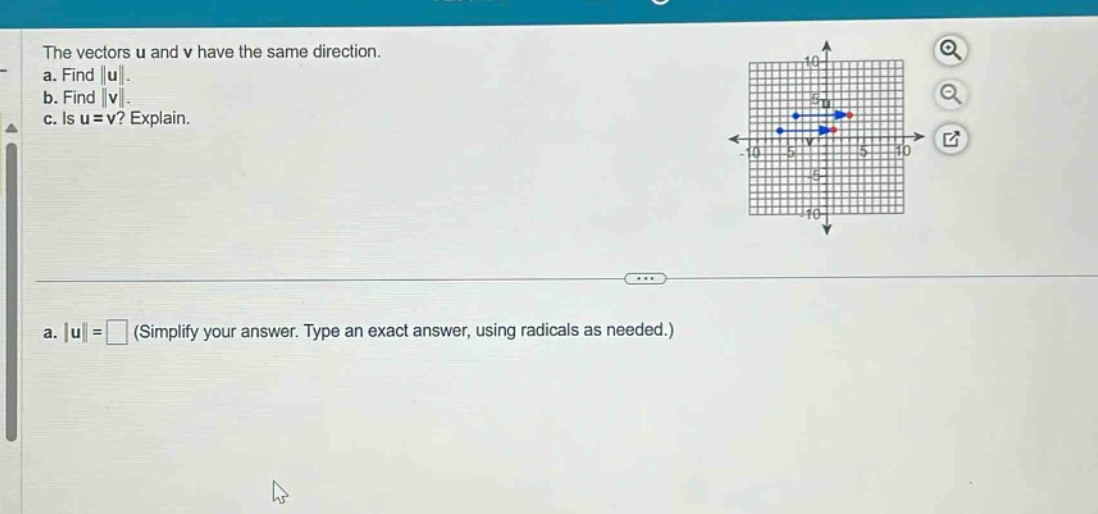
the vectors u and v have the same direction.\na. find |u|.\nb. find |v|.\nc. is u = v? explain.\na. |u| = (simplify your answer. type an exact answer, using radicals as needed.)
Answer
Explanation:
Step1: Assume vector u has initial point $(x_1,y_1)$ and terminal point $(x_2,y_2)$
Let's assume from the grid - if we can identify the coordinates. For a two - dimensional vector $\mathbf{u}=\langle x_2 - x_1,y_2 - y_1\rangle$, the magnitude of the vector $\mathbf{u}$ is given by the formula $|\mathbf{u}|=\sqrt{(x_2 - x_1)^2+(y_2 - y_1)^2}$. Suppose the initial point of $\mathbf{u}$ is $(x_1,y_1)=(0,0)$ and the terminal point is $(x_2,y_2)=(3,0)$ (assuming grid - based coordinates), then $\mathbf{u}=\langle3 - 0,0 - 0\rangle=\langle3,0\rangle$. $|\mathbf{u}|=\sqrt{(3 - 0)^2+(0 - 0)^2}=\sqrt{3^2+0^2}=3$
Step2: Assume vector v has initial point $(x_3,y_3)$ and terminal point $(x_4,y_4)$
Similarly, for vector $\mathbf{v}$, if its initial point is $(x_3,y_3)=(5,0)$ and terminal point is $(x_4,y_4)=(8,0)$, then $\mathbf{v}=\langle8 - 5,0 - 0\rangle=\langle3,0\rangle$. $|\mathbf{v}|=\sqrt{(8 - 5)^2+(0 - 0)^2}=\sqrt{3^2+0^2}=3$
Step3: Check if $\mathbf{u}=\mathbf{v}$
Two vectors $\mathbf{u}=\langle u_1,u_2\rangle$ and $\mathbf{v}=\langle v_1,v_2\rangle$ are equal if $u_1 = v_1$ and $u_2 = v_2$. Since $\mathbf{u}=\langle3,0\rangle$ and $\mathbf{v}=\langle3,0\rangle$, $\mathbf{u}=\mathbf{v}$.
Answer:
a. $|\mathbf{u}| = 3$ b. $|\mathbf{v}| = 3$ c. Yes, because they have the same magnitude and direction. In component - form, if we assume appropriate coordinates from the grid, they have the same components.