the vertex form of a function is $g(x)=(x - 3)^2+9$. how does the graph of $g(x)$ compare to the graph of…
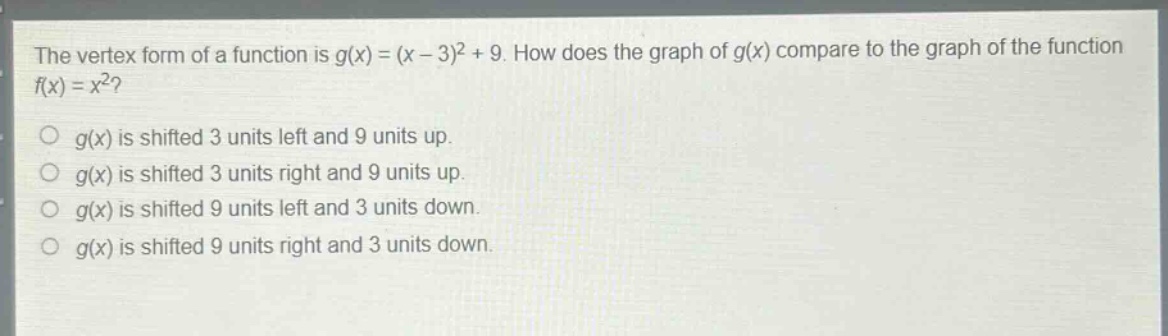
the vertex form of a function is $g(x)=(x - 3)^2+9$. how does the graph of $g(x)$ compare to the graph of the function $f(x)=x^2$?\n$g(x)$ is shifted 3 units left and 9 units up.\n$g(x)$ is shifted 3 units right and 9 units up.\n$g(x)$ is shifted 9 units left and 3 units down.\n$g(x)$ is shifted 9 units right and 3 units down.
Answer
Explanation:
Step1: Recall vertex - form transformation rules
For a quadratic function $y = a(x - h)^2+k$, compared to $y = ax^2$, the graph is shifted $h$ units horizontally and $k$ units vertically.
Step2: Identify $h$ and $k$ values
In $g(x)=(x - 3)^2+9$, we have $h = 3$ and $k = 9$.
Step3: Determine the shift
Since $h=3>0$, the graph is shifted 3 units to the right. Since $k = 9>0$, the graph is shifted 9 units up.
Answer:
$g(x)$ is shifted 3 units right and 9 units up.