the vertex of a parabola that opens downward is at (0, 4). the vertex of a second parabola is at (0, -4). if…
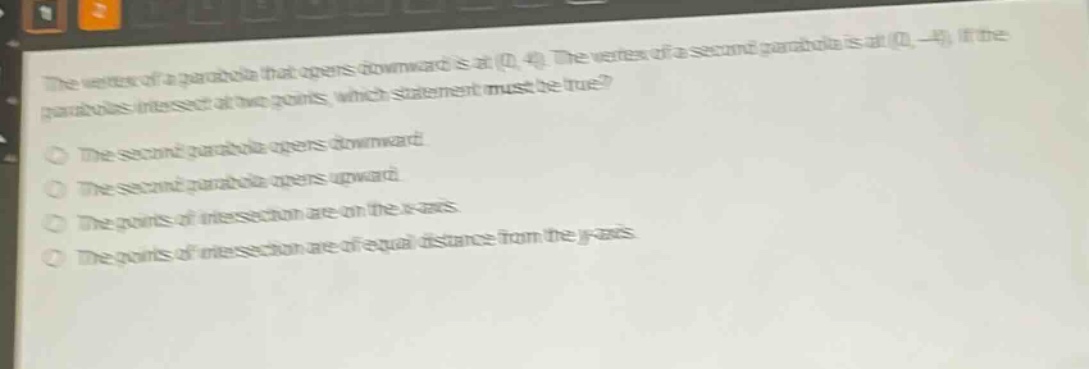
the vertex of a parabola that opens downward is at (0, 4). the vertex of a second parabola is at (0, -4). if the parabolas intersect at two points, which statement must be true?\nthe second parabola opens downward.\nthe second parabola opens upward.\nthe points of intersection are on the x - axis.\nthe points of intersection are of equal distance from the y - axis.
Answer
Explanation:
Step1: Analyze the symmetry of parabolas
Parabolas are symmetric about their axes of symmetry. For a parabola with vertex ((0,4)) (opens downward) and another with vertex ((0, - 4)), their axes of symmetry is the (y) - axis ((x = 0)). If two parabolas intersect at two points, due to the symmetry about the (y) - axis ((x=0)), if ((x,y)) is a point of intersection, then ((-x,y)) is also a point of intersection. The distance of a point ((x,y)) from the (y) - axis is (|x|), and the distance of the point ((-x,y)) from the (y) - axis is (|-x|=|x|).
Step2: Analyze other options
- Option 1: The second parabola could open upward or downward. Just because the first parabola opens downward does not force the second one to open downward. For example, (y=-x^{2}+4) (opens down, vertex ((0,4))) and (y = x^{2}-4) (opens up, vertex ((0,-4))) intersect.
- Option 2: The second parabola could open upward or downward. For example, (y=-x^{2}+4) (opens down, vertex ((0,4))) and (y=-2x^{2}-4) (opens down, vertex ((0, - 4))) intersect.
- Option 3: Let (y_1=-ax^{2}+4(a>0)) and (y_2 = bx^{2}-4(b>0)). Set (y_1=y_2), then (-ax^{2}+4=bx^{2}-4), ((a + b)x^{2}=8), (x=\pm\sqrt{\frac{8}{a + b}}), (y=\frac{4b-4a}{a + b}). The (y) - coordinate is not necessarily (0).
Answer:
The points of intersection are of equal distance from the (y) - axis.