the vertices of a quadrilateral on the coordinate plane are (2, 4), (-4, -2), (-2, 4), and (4, -2). what…
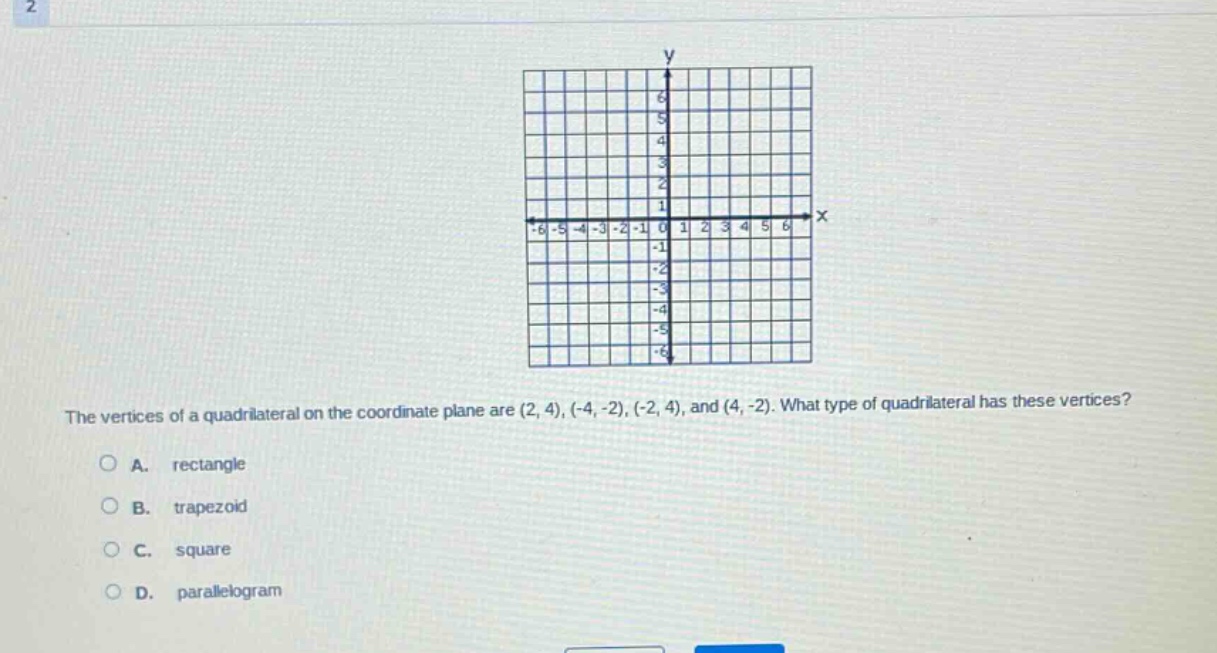
the vertices of a quadrilateral on the coordinate plane are (2, 4), (-4, -2), (-2, 4), and (4, -2). what type of quadrilateral has these vertices?\na. rectangle\nb. trapezoid\nc. square\nd. parallelogram
Answer
Explanation:
Step1: Calculate the slopes of the sides
Use the slope - formula $m=\frac{y_2 - y_1}{x_2 - x_1}$. Let $A(2,4)$, $B(-4,-2)$, $C(-2,4)$, $D(4,-2)$. Slope of $AB$: $m_{AB}=\frac{-2 - 4}{-4 - 2}=\frac{-6}{-6}=1$. Slope of $BC$: $m_{BC}=\frac{4+2}{-2 + 4}=\frac{6}{2}=3$. Slope of $CD$: $m_{CD}=\frac{-2 - 4}{4+2}=\frac{-6}{6}=-1$. Slope of $DA$: $m_{DA}=\frac{4 + 2}{2 - 4}=\frac{6}{-2}=-3$. Since $m_{AB}\times m_{CD}=1\times(-1)=-1$, $AB\perp CD$. But the other adjacent - side slopes do not have a product of $-1$, so it is not a rectangle or a square.
Step2: Check for parallel sides
Parallel lines have equal slopes. Since no two non - adjacent sides have equal slopes, it is not a parallelogram. A trapezoid has one pair of parallel sides. Since no sides are parallel, we made a wrong approach. Let's use the distance formula $d=\sqrt{(x_2 - x_1)^2+(y_2 - y_1)^2}$. Distance between $A(2,4)$ and $B(-4,-2)$: $d_{AB}=\sqrt{(-4 - 2)^2+(-2 - 4)^2}=\sqrt{(-6)^2+(-6)^2}=\sqrt{36 + 36}=\sqrt{72}=6\sqrt{2}$. Distance between $B(-4,-2)$ and $C(-2,4)$: $d_{BC}=\sqrt{(-2 + 4)^2+(4 + 2)^2}=\sqrt{2^2+6^2}=\sqrt{4 + 36}=\sqrt{40}=2\sqrt{10}$. Distance between $C(-2,4)$ and $D(4,-2)$: $d_{CD}=\sqrt{(4 + 2)^2+(-2 - 4)^2}=\sqrt{6^2+(-6)^2}=\sqrt{36+36}=\sqrt{72}=6\sqrt{2}$. Distance between $D(4,-2)$ and $A(2,4)$: $d_{DA}=\sqrt{(2 - 4)^2+(4 + 2)^2}=\sqrt{(-2)^2+6^2}=\sqrt{4 + 36}=\sqrt{40}=2\sqrt{10}$. The opposite sides are equal ($d_{AB}=d_{CD}$ and $d_{BC}=d_{DA}$). Slope of $AB$: $m_{AB}=\frac{-2 - 4}{-4 - 2}=1$. Slope of $CD$: $m_{CD}=\frac{-2 - 4}{4 + 2}=-1$. Slope of $BC$: $m_{BC}=\frac{4 + 2}{-2+4}=3$. Slope of $DA$: $m_{DA}=\frac{4 + 2}{2 - 4}=-3$. Since the opposite sides are equal and the adjacent sides are not perpendicular, it is a parallelogram.
Answer:
D. parallelogram