vince wrote the sequence below.\n$\frac{1}{3},1,\frac{5}{3},\frac{7}{3},cdots$\nwhich of the following…
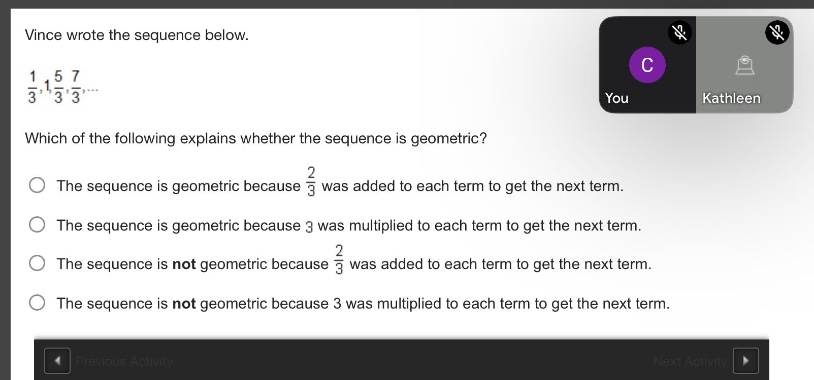
vince wrote the sequence below.\n$\frac{1}{3},1,\frac{5}{3},\frac{7}{3},cdots$\nwhich of the following explains whether the sequence is geometric?\nthe sequence is geometric because $\frac{2}{3}$ was added to each term to get the next term.\nthe sequence is geometric because 3 was multiplied to each term to get the next term.\nthe sequence is not geometric because $\frac{2}{3}$ was added to each term to get the next term.\nthe sequence is not geometric because 3 was multiplied to each term to get the next term.
Answer
Explanation:
Step1: Recall geometric - sequence definition
A geometric sequence has a common ratio, i.e., $\frac{a_{n + 1}}{a_{n}}=r$ (constant), where $a_{n}$ is the $n$th term and $a_{n+1}$ is the $(n + 1)$th term. If we add a number to each term to get the next term, it is an arithmetic sequence.
Step2: Analyze the given sequence
The given sequence is $\frac{1}{3},1,\frac{5}{3},\frac{7}{3},\cdots$. $1-\frac{1}{3}=\frac{2}{3}$, $\frac{5}{3}-1=\frac{2}{3}$, $\frac{7}{3}-\frac{5}{3}=\frac{2}{3}$. We are adding $\frac{2}{3}$ to each term to get the next term, so it is an arithmetic sequence, not a geometric sequence.
Answer:
The sequence is not geometric because $\frac{2}{3}$ was added to each term to get the next term.