the volume of a rectangular prism is $2x^{3}+9x^{2}-8x - 36$ with height $x + 2$. using synthetic division…
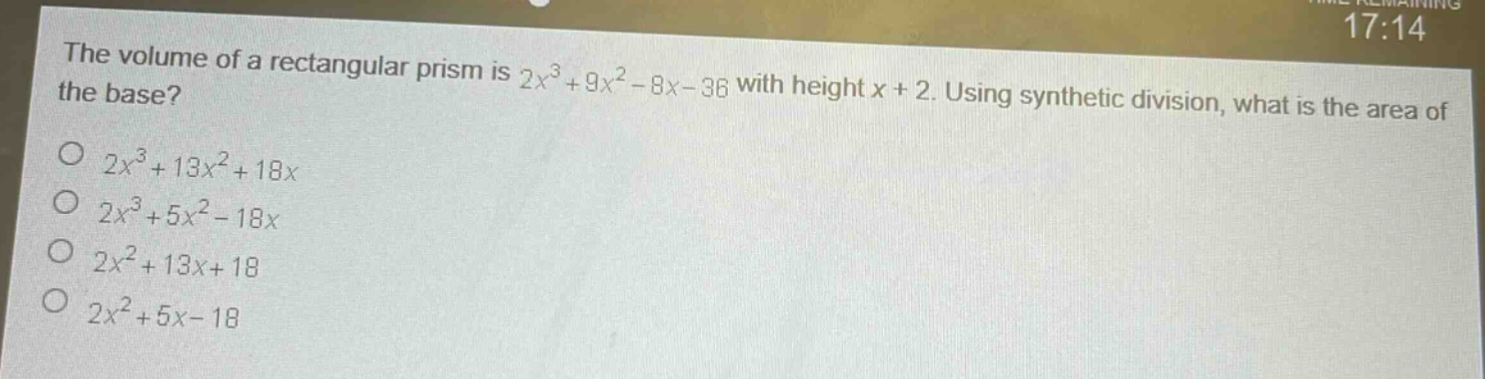
the volume of a rectangular prism is $2x^{3}+9x^{2}-8x - 36$ with height $x + 2$. using synthetic division, what is the area of the base?\n$2x^{3}+13x^{2}+18x$\n$2x^{3}+5x^{2}-18x$\n$2x^{2}+13x + 18$\n$2x^{2}+5x-18$
Answer
Answer:
D. $2x^{2}+5x - 18$
Explanation:
Step1: Recall the volume formula
$V=Bh$ (where $V$ is volume, $B$ is base - area and $h$ is height). We want to find $B$, so $B=\frac{V}{h}$. Here, $V = 2x^{3}+9x^{2}-8x - 36$ and $h=x + 2$.
Step2: Set up synthetic division
For synthetic division of $2x^{3}+9x^{2}-8x - 36$ by $x + 2$, we use $- 2$ (since $x+2=0$ gives $x=-2$). The coefficients are $2,9,-8,-36$.
Step3: Perform synthetic - division
Bring down the first coefficient $2$: Multiply $-2\times2=-4$, add to the second coefficient: $9+( - 4)=5$. Multiply $-2\times5=-10$, add to the third coefficient: $-8+( - 10)=-18$. Multiply $-2\times(-18)=36$, add to the fourth coefficient: $-36 + 36=0$. The quotient is $2x^{2}+5x - 18$ which is the area of the base.