what whole number value of n makes the equation \\(\\frac{(27^2)^3 \\cdot 27^5}{27^n} = 27^2\\) true? use…
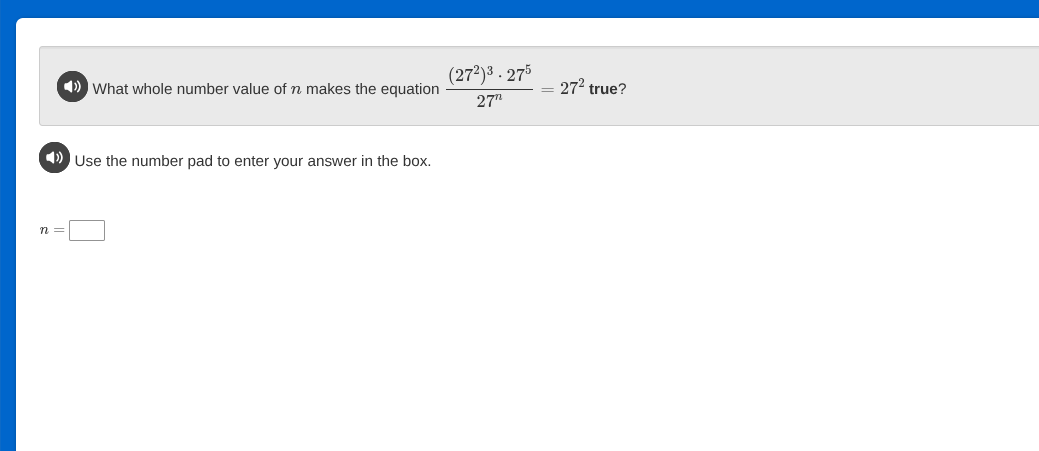
what whole number value of n makes the equation \\(\\frac{(27^2)^3 \\cdot 27^5}{27^n} = 27^2\\) true? use the number pad to enter your answer in the box. \\(n = \\square\\)
Answer
Explanation:
Step1: Simplify the numerator using exponent rules
First, use the power of a power rule ((a^m)^n = a^{m \cdot n}) on ((27^2)^3). So ((27^2)^3 = 27^{2 \cdot 3}=27^6). Then, use the product of powers rule (a^m \cdot a^n = a^{m + n}) to multiply (27^6) and (27^5). So (27^6 \cdot 27^5 = 27^{6 + 5}=27^{11}). Now the left - hand side of the equation becomes (\frac{27^{11}}{27^n}).
Step2: Use the quotient of powers rule
The quotient of powers rule is (a^m\div a^n=a^{m - n}), so (\frac{27^{11}}{27^n}=27^{11 - n}).
Step3: Solve for n
We know that (\frac{(27^2)^3\cdot27^5}{27^n}=27^2), and from the previous steps, the left - hand side is (27^{11 - n}). So we set up the equation (27^{11 - n}=27^2). Since the bases are the same, we can set the exponents equal to each other: (11 - n = 2). Solving for n, we subtract 11 from both sides: (-n=2 - 11=-9), and then multiply both sides by - 1 to get (n = 9).
Answer:
(n = 9)