write an equation for the cubic polynomial function whose graph has zeroes at 2, 3, and 5.\n- can any of the…
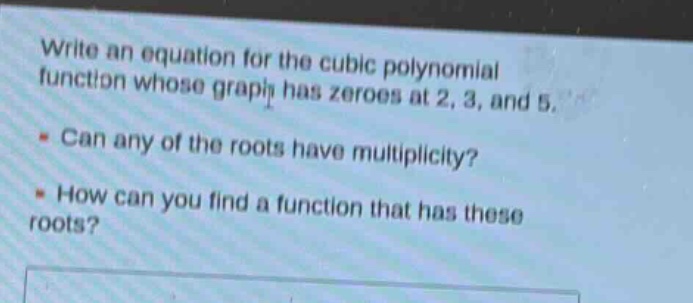
write an equation for the cubic polynomial function whose graph has zeroes at 2, 3, and 5.\n- can any of the roots have multiplicity?\n- how can you find a function that has these roots?
Answer
Answer:
- The cubic polynomial function with zeros at (x = 2), (x=3), and (x = 5) is (y=a(x - 2)(x - 3)(x - 5)), where (a\neq0). When (a = 1), the function is (y=(x - 2)(x - 3)(x - 5)).
- Yes, any of the roots can have multiplicity. For example, if the root (x = 2) has multiplicity 2, the polynomial would be (y=(x - 2)^2(x - 3)(x - 5)); if (x=3) has multiplicity 3, the polynomial would be (y=(x - 2)(x - 3)^3(x - 5)) and so on.
- To find a function that has these roots, we use the fact that if (r) is a root of a polynomial, then ((x - r)) is a factor of the polynomial. So for roots (r_1=2), (r_2 = 3), and (r_3=5), the polynomial is the product of the factors ((x - r_1)(x - r_2)(x - r_3)) multiplied by a non - zero constant (a).
Explanation:
Step1: Recall factor - root relationship
If (x = r) is a root of a polynomial, then ((x - r)) is a factor. For roots (2), (3), and (5), the factors are ((x - 2)), ((x - 3)), and ((x - 5)). The general form of the cubic polynomial is (y=a(x - 2)(x - 3)(x - 5)) with (a\neq0). When (a = 1), we have (y=(x - 2)(x - 3)(x - 5)).
Step2: Understand root multiplicity
Root multiplicity means the number of times a root appears. If a root (r) has multiplicity (k), then the factor ((x - r)) appears (k) times in the polynomial. So any of (2), (3), or (5) can have a multiplicity greater than 1.
Step3: Summarize the method of finding the polynomial
The fundamental principle is that for a polynomial, if (r_1,r_2,\cdots,r_n) are its roots, the polynomial can be written as (y=a(x - r_1)(x - r_2)\cdots(x - r_n)), where (a\neq0). Here (r_1 = 2), (r_2=3), (r_3 = 5), so we form the polynomial using these factors.