write an equation for the function graphed below y =
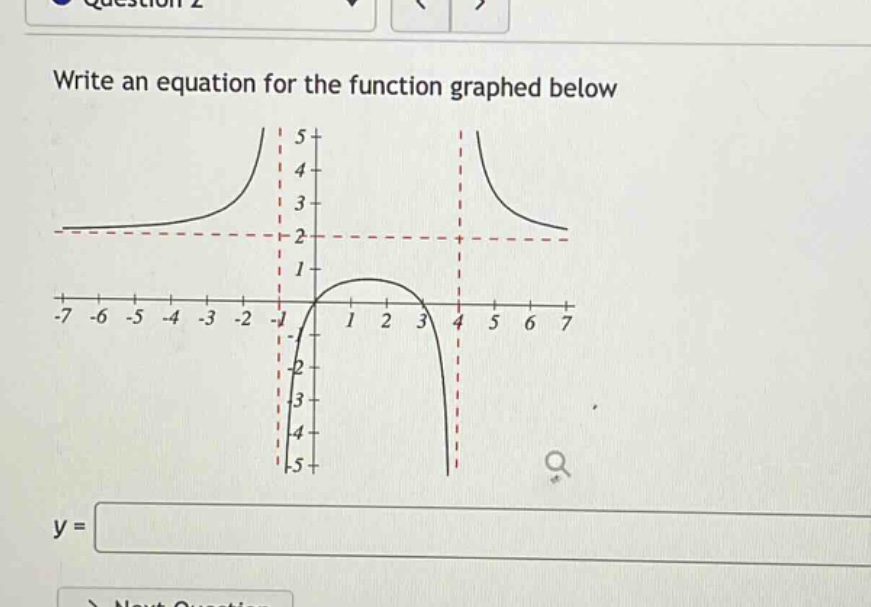
write an equation for the function graphed below y =
Answer
Explanation:
Step1: Identify vertical asymptotes
The vertical asymptotes are at $x=- 1$ and $x = 4$. So, the denominator of a rational - function will have factors of $(x + 1)$ and $(x - 4)$, i.e., the denominator $q(x)=(x + 1)(x - 4)=x^{2}-3x - 4$.
Step2: Identify horizontal asymptote
The horizontal asymptote is $y = 2$. For a rational function $y=\frac{p(x)}{q(x)}$ where the degree of $p(x)$ and $q(x)$ are the same, if $y = a$ is the horizontal asymptote, the leading - coefficient of the numerator and denominator are in the ratio $a$. Let the numerator be $p(x)=2x^{2}+bx + c$.
Step3: Identify x - intercepts
The x - intercept is between $0$ and $3$. Let's assume the numerator can be factored to account for the x - intercept. Since the function has a single x - intercept (from the graph), we can assume the numerator is of the form $p(x)=2(x - h)^{2}+k$. Another way is to note that since the horizontal asymptote is $y = 2$ and we want an x - intercept, we can start with a rational function of the form $y = 2+\frac{r(x)}{(x + 1)(x - 4)}$. When $y = 0$, we have $0=2+\frac{r(x)}{(x + 1)(x - 4)}$, or $\frac{r(x)}{(x + 1)(x - 4)}=-2$. A simple form is to consider a constant numerator for the additional fraction. Let's try $y = 2-\frac{10}{(x + 1)(x - 4)}$. [ \begin{align*} y&=2-\frac{10}{x^{2}-3x - 4}\ &=\frac{2(x^{2}-3x - 4)-10}{x^{2}-3x - 4}\ &=\frac{2x^{2}-6x-8 - 10}{x^{2}-3x - 4}\ &=\frac{2x^{2}-6x - 18}{x^{2}-3x - 4} \end{align*} ]
Answer:
$y = 2-\frac{10}{(x + 1)(x - 4)}$